

When the question needs an operator’s read, not an analyst’s
QSR is a structurally specific channel. The unit economics are different, the menu architecture works differently, the operational throughput is different, the supply chain pressures are different, and the consumer proposition lives in a different commercial logic than retail, foodservice or hospitality. That specificity is exactly why a generalist review will only get you so far – it will catch the visible signals but miss the operational reality underneath: the kitchen flow, the supply chain decisions that make the unit economics work, the real estate model that shapes the rollout.
Our operations review is a structured, multi-lens read of your business – covering operations and unit economics, menu architecture and food, brand and consumer proposition, supply chain and procurement, and real estate. Run by senior specialists with primary QSR operating experience, the work is designed to pinpoint inefficiencies, surface opportunities and identify the changes that will move the needle on consistency, speed and profitability.

What we do differently
-
Senior operators, not analysts
The senior people on every QSR review have run the operations they are now reviewing. Buyers, NPD leads, operations directors, supply chain heads, real estate principals. The work is read through the lens of someone who has actually made the operational decisions, not someone who has read about them. This is the single biggest gap between us and generalist M&A advisory on QSR work, and the reason buyers come back.
-
Operations-first, not consumer-first
Most reviews of QSR brands start with the consumer proposition and the brand. Ours starts with the operations: throughput, unit economics, supply chain reliability, real estate model. The consumer and brand work matters and is covered fully, but the operational read is what separates a credible review from a marketing-flavoured one. The order matters in QSR specifically because the operations are the proposition.
-
Primary observation where the brief allows
Where the brief allows, we run primary site visits in the operator's estate: peak service observation, off-peak observation, multi-unit comparison to read the operational standard across the estate rather than against a single flagship. Most reviews skip this because it is operationally harder and more expensive. We do it because the operational signal lives in the variance across the estate, not in the press release.
-
Discretion where it matters
Acquisition work, competitive intelligence and PE diligence all require discretion in how the work is run and how the team is briefed. Our protocols are designed for this. We work under NDA throughout, the senior team is small and named on the engagement, primary observation is run without the operator being aware where that is the brief, and the deliverable is built for the audience that has to see it (board, deal team, investment committee) without surfacing more widely than agreed.
Food and drink is all we do
We are not a generalist M&A advisory firm that takes the occasional QSR mandate. Food and drink is the only sector we work in. Our senior team has operated in QSR and the wider food and drink industry directly, which is why the work reads as operationally credible to other operators. Briefs land with people who get it on the first read, and recommendations come back framed for the people who actually have to make the decision.
That focus is why we work with 11 of the UK’s top 40 food and drink brands.
Other ways to decode QSR and the wider category
QSR operation review is one tool in the broader Decode toolkit. Depending on the brief, one of these might be a better fit, or a stronger partner alongside the review work.
-

Food Safaris & Competitor Review
A bespoke exploration of the markets, restaurants, retail aisles and overseas territories that are shaping your category
-

Consumer and Category Data Immersion
Structured deep-dives that immerse marketing, NPD, innovation and category teams in the category, consumer and the competitive landscape.
-

Usage and Attitude Studies
Foundational consumer research that maps category usage, brand awareness, consumer attitudes and the drivers of choice across the audiences that matter.
-

Opportunity Mapping
Strategic mapping of where to play in food and drink.

View our case studies
-

Life Health Foods
A food business with limited insight history needed a robust foundation to inform category strategy, retail partnerships and brand vision. FIS Group delivered an end-to-end programme from stakeholder workshops to quantitative validation, creating a living strategic resource the whole business now builds from.
-
Mizkan
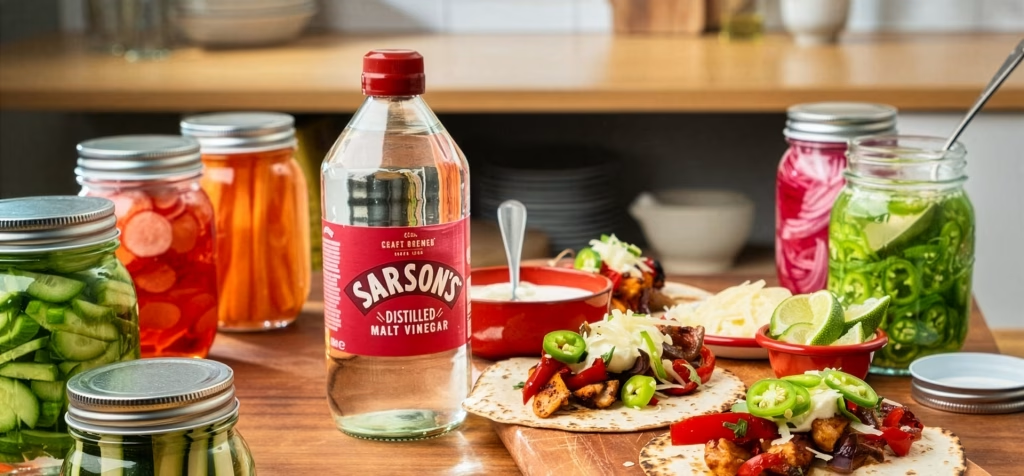
Mizkan needed a growth strategy to attract younger consumers to the vinegar category and expand usage occasions. FIS Group delivered a hybrid process combining trend mapping, consumer research and innovation workshop facilitation, producing high-potential proposition territories with a full activation toolkit for development.
-

Pizza Express
Pizza Express needed trend-led hero dishes for their Christmas 2024 and September seasonal launches. FIS Group delivered a two-phase innovation sprint from concept ideation through kitchen development to full supplier briefing specifications, with all menu items reaching restaurants nationwide on schedule.
FAQs
Senior food and drink specialists with primary QSR operating experience. Former buyers, NPD leads, operations directors, supply chain heads, real estate principals. The senior person you meet on the scoping call is the senior person who runs the review and presents the recommendation. No handover to junior analysts or freelancers between scoping, delivery and debrief.
Two structural differences. First, the operating bias: our senior team has actually run QSR operations, where big four diligence teams typically have analytical experience but not operating experience. Second, the sector specialism: food and drink is the only sector we work in, where big four advisory covers every sector. The result is a review that reads as operationally credible to other operators, which matters when the audience for the work is a QSR-experienced board or deal team.
Both, sequenced correctly. The desk-based intelligence build is the foundation (financial filings, trade press, real estate filings, supplier relationships, operational signal from public and proprietary sources). The primary site visits are where the operational reality gets read: peak service, off-peak, multi-unit comparison, mystery shopping. Where the brief allows it, the primary observation is run across multiple sites in the estate, not just at a flagship.
Yes. Discretion is a standard feature of the work, not an exception. We operate under NDA throughout, the senior team is small and named on the engagement, primary observation is run without the target operator being aware where that is appropriate, and the deliverable is built for the audience that has to see it (deal team, investment committee, board) without surfacing more widely than agreed. The protocols are designed for M&A and PE work.
Five lenses, run together: operations and unit economics, menu architecture and food, brand and consumer proposition, supply chain and procurement, real estate and operational replicability. The cross-functional integration is the value: the operational reality, the menu architecture, the supply chain and the rollout case have to be read together to land a commercially credible recommendation, and that integration is the part most generalist reviews skip.
Yes. We run international QSR reviews across mainland Europe, the US, the UAE and further afield. International work is run with senior FIS Group leads alongside trusted local specialists, so the on-the-ground operational read has both the FIS Group quality bar and the local market knowledge.
A focused competitive review on a single operator typically runs four to six weeks from brief to debrief. M&A diligence and deeper benchmark work typically runs six to ten weeks depending on the operator scope, the primary observation requirement and the audience for the deliverable. Compressed timelines are possible for deal-driven work where the timeline is dictated by the transaction.
Yes. The work is run in a form deal teams and investment committees can use, and is designed to sit alongside (rather than replace) the financial and legal diligence streams. Most M&A and PE buyers commission the operational review as one workstream inside a broader diligence process. We will scope the engagement around the diligence calendar and the audience for the deliverable.
A structured written report and a debrief session, scoped to the audience. For M&A and PE work, the deliverable is typically formatted for a deal team or investment committee: executive summary, the five lenses, integrated commercial read, recommendation against the original brief. For competitive review and benchmarking work, the deliverable is typically formatted for an internal commercial or leadership audience. Format is agreed at the start.
Project-based, scoped around the operator scope, the depth of primary observation, the geographic scope and the discretion required. UK competitive review work is the lowest entry point; international M&A diligence with primary observation across multiple territories is the highest. We give a clear, all-in quote at proposal stage with no hidden extras, and we will tell you straight if your budget will not buy the depth your brief requires.
Got a QSR operator you need to understand operationally?
Tell us the operator (or operators), the commercial question the review has to inform, and the level of discretion required. We will tell you whether a QSR operation review is the right answer, what depth makes sense, what we can credibly cover, and what it will cost. Twenty minutes on a call, under NDA from the start if the brief requires it.