
The challenge
Not every food business grows up with an insight function at its side.
Our client had historically had limited access to bespoke category and consumer insight, and the gap was starting to matter: category strategy, retail partnership development and brand vision all needed firmer ground to stand on.
What they required was not a one-off survey but a robust foundational programme, a single body of evidence the whole business could build from. Starting from a blank page is a different discipline to topping up an existing knowledge base, and the programme had to be designed accordingly.
What we did
Stakeholder workshop facilitation, trend and foresight mining, qualitative consumer exploration, quantitative occasion and category validation, insight synthesis and a strategic implications workshop.
How we did it
We designed and delivered an end-to-end insight programme across several connected phases, each one feeding the next.
It began with an in-depth stakeholder workshop to align on scope and audit existing knowledge. Even businesses without formal insight hold more understanding than they realise, in sales data, in customer conversations, in the instincts of experienced people, and capturing it first means the research budget goes on genuine unknowns rather than confirming what the business already knows.
A deep trend and foresight mining phase followed, drawing on both our own IP and partner expertise to map where the category and the wider world of food are heading. With the future context set, a qualitative consumer exploration phase examined the motivations, needs and barriers shaping engagement across key occasions and audiences, getting underneath behaviour to the reasons behind it.
Quantitative validation then scaled those learnings, measuring attitudes, behaviours, decision hierarchies and brand perceptions with the robustness needed to carry commercial weight in retailer conversations. Qualitative depth tells you what might be true; quantitative scale tells you how true, and for whom.
Finally, all outputs were brought together in a strategic implications workshop, designed to move stakeholders from insight into active decision-making. Research that stops at a debrief deck has not finished its job; this session was built to end with choices made.

What it delivered
A complete insight foundation where little had existed before: future-facing trend context, deep qualitative understanding, quantified validation across occasions and audiences, and a leadership team that has worked through the implications together.
The programme now informs category strategy, retail partnership development and brand vision, and it has been embedded as a living strategic resource across the business, used and added to rather than filed away.
This is the kind of work we find most satisfying. There is a particular pleasure in giving a business its first proper view of its own consumers and category, because everything built afterwards stands on it. We start with your challenge, not our methods, and when the challenge is a foundation, the answer is a programme designed to last well beyond the final debrief.
View more case studies
-

HelloFresh
HelloFresh needed a clear, consumer-evidenced view of where their next stage of growth could come from. FIS Group combined international qualitative research, data mining and a two-day innovation workshop to produce a prioritised pipeline across three platform roadmaps, grounded in both fresh insight and the company's own knowledge base.
-
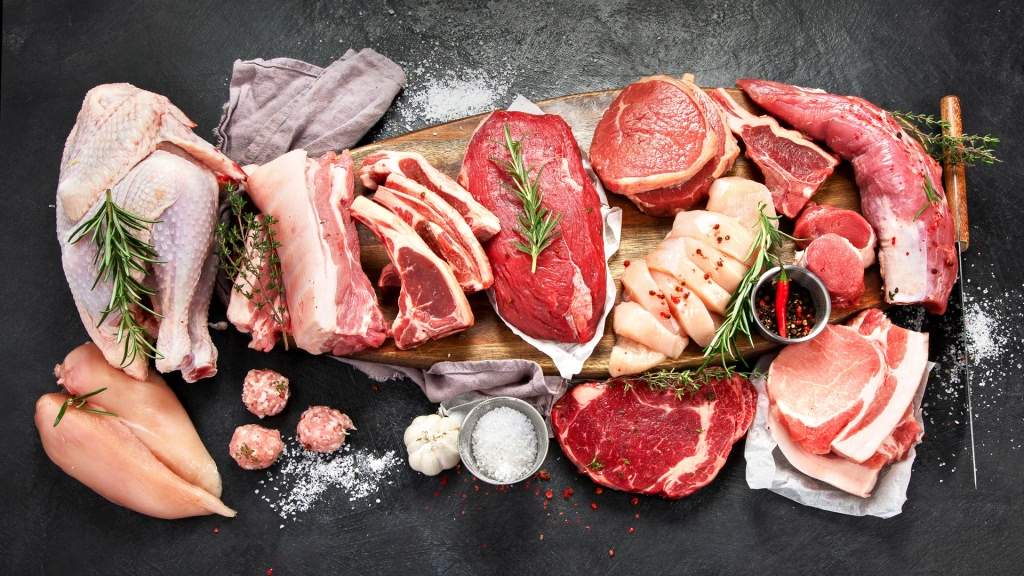
Pilgrim's Europe
Pilgrim's Europe needed a future-ready portfolio strategy balancing core business strength with breakthrough innovation. FIS Group delivered a bespoke Future Food process combining trend mapping, consumer insight, cross-functional ideation and rigorous validation, producing a fully evidenced long-term innovation roadmap.
-
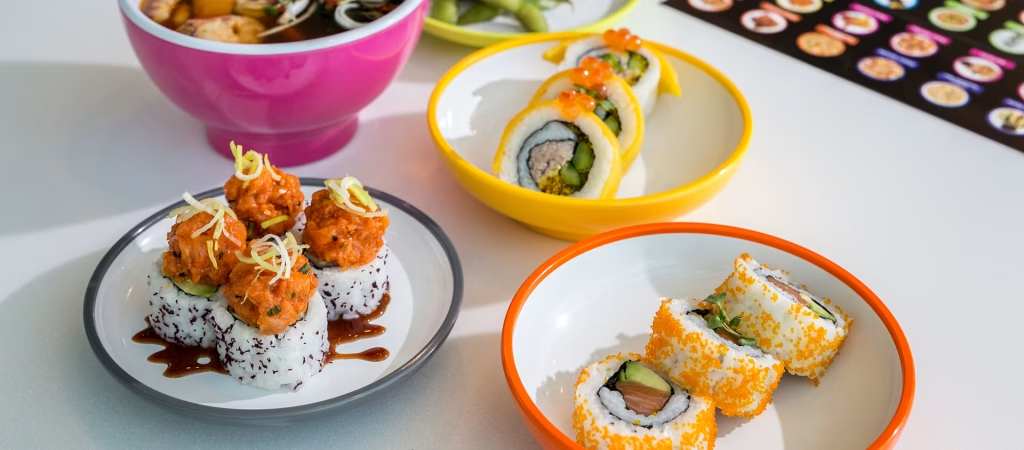
YO!
YO! needed to understand customers across three channels while balancing growth with brand loyalty. FIS Group combined quantitative survey work with agile listening groups to shape twelve months of marketing decisions.

Got a brief? Let’s talk.
Tell us what you are working on. We will tell you straight whether we can help, what the right approach looks like, and how quickly we can move. No long discovery dance, no qualifying call before the qualifying call.