

Five lenses. One integrated view of future growth.
Growth opportunities rarely sit within a single dimension. They emerge where consumer needs, category dynamics, macro trends and commercial realities intersect. Our approach explores five interconnected lenses, bringing them together into a single, prioritised view of where the greatest opportunities exist and which jobs-to-be-done remain underserved. Some projects focus more heavily on one or two lenses; most strategic growth decisions require the integrated picture across all five.
Consumer Opportunities
Consumer Opportunities
Understanding who has the greatest unmet needs and where future demand is emerging. We identify consumer groups based on behaviours, motivations, attitudes and jobs-to-be-done, rather than demographics alone. The result is a clearer view of the consumers whose needs offer the strongest opportunities for growth, innovation and value creation.
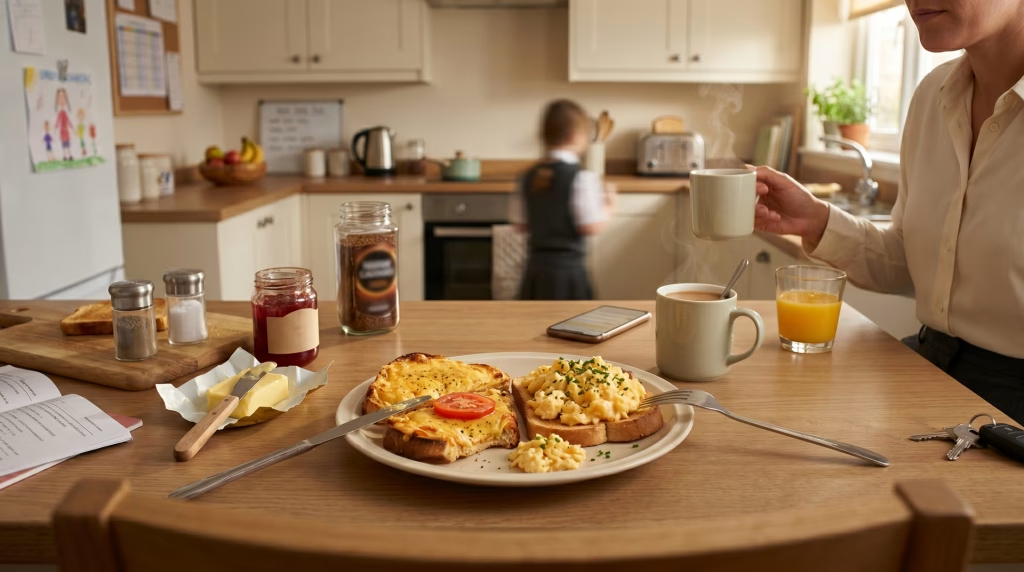
Occasion opportunities
Understanding when needs arise and the role food and drink can play in fulfilling them. We explore eating and drinking occasions, from everyday routines to emerging consumption moments, to identify unmet needs, shifting behaviours and opportunities for brands to create greater relevance and value.
Territory opportunities and Category opportunities
Territory opportunities
Understanding which need spaces and proposition territories offer the greatest potential. By combining consumer insight, category trends and cultural shifts, we identify the territories where demand is growing, needs remain underserved, and brands can credibly establish meaningful differentiation.
Category opportunities
Understanding where category evolution is creating new avenues for growth. We assess existing categories, adjacencies and emerging spaces to identify where consumer needs are changing, where innovation is required, and where future value pools are likely to develop.

Channel opportunities
Understanding where opportunities can most effectively be realised. We examine how consumers discover, purchase and consume food and drink across retail, foodservice and digital environments, identifying the channels best positioned to unlock growth and bring new propositions to market.
Food and drink is all we do
We are not a generalist strategy consultancy that takes the occasional food brief. Food and drink is the only sector we work in. Our senior team knows the categories, the audiences, the occasions, the channels and the operational realities of this sector. The mapping reads against the real commercial environment the brand operates in, and the prioritisation is anchored in food and drink experience rather than in generalist strategic frameworks that treat food and drink as one sector among many.
That focus is why we work with 11 of the UK’s top 40 food and drink brands.
Other ways to unlock growth opportunities
Opportunity Mapping is one tool in the broader Unlock Growth Opportunities toolkit. Depending on the brief, one of these might be a better fit, or a stronger partner alongside the mapping work.
-

Future Food Pipeline Builder
A structured methodology for building credible, sequenced, executable food and drink innovation pipelines.
-

Platform & Territory Building
Deep platform development that picks up where opportunity mapping ends and where execution begins.
-
i360 Audit & Growth Transformation
A comprehensive growth audit and transformation programme for food and drink businesses.
-
Needs Landscaping
Structured consumer-needs mapping that surfaces the unmet, under-served and emerging needs worth commercial attention.

View our case studies
-
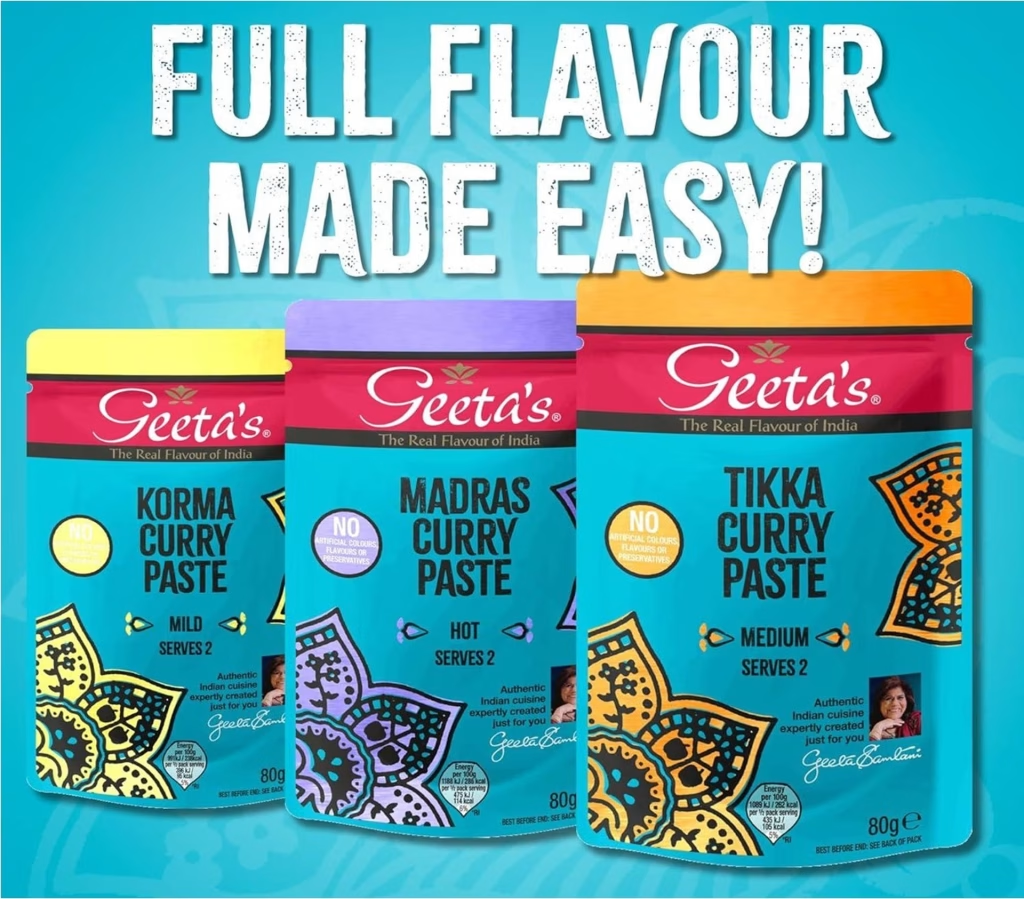
Geeta's
Geeta's commissioned FIS Group to expand their portfolio into curry pastes and chutneys, building on a successful earlier partnership. We developed three new paste flavours in pouch format and a range of savoury chutney recipes, each rooted in authentic Indian flavour but designed for UK consumers and existing manufacturing capabilities.
-
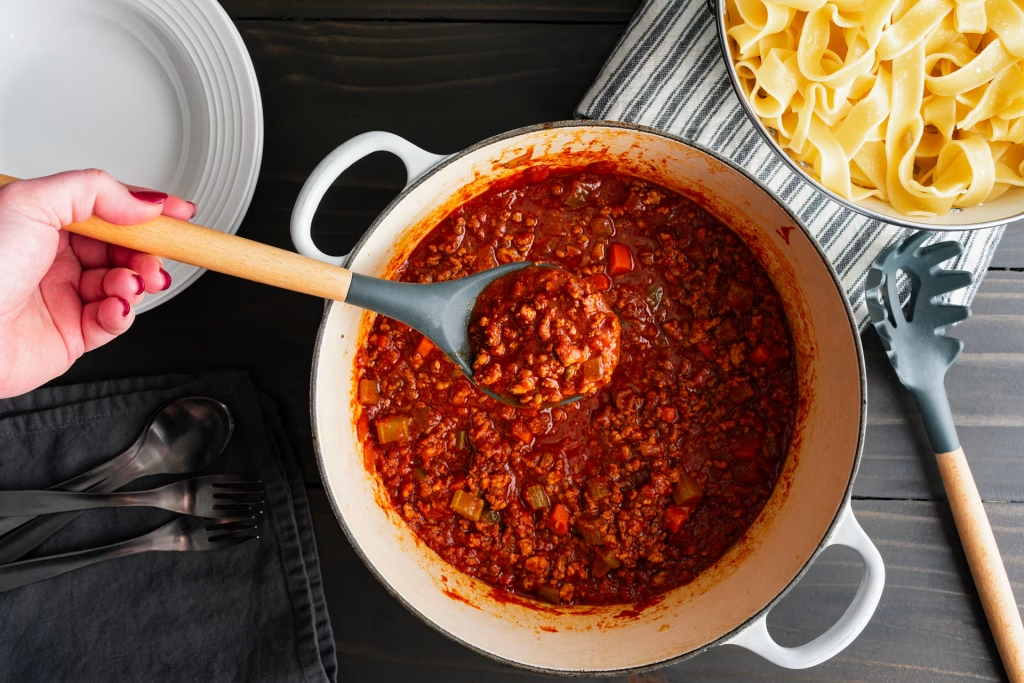
Mars
Mars needed a true research partner to decode consumer meal behaviour across three markets. FIS Group delivered a bespoke Meal Moments programme combining in-the-moment diary capture, qualitative exploration and strategic workshop facilitation – turning occasion-level data into immediate commercial direction.
-
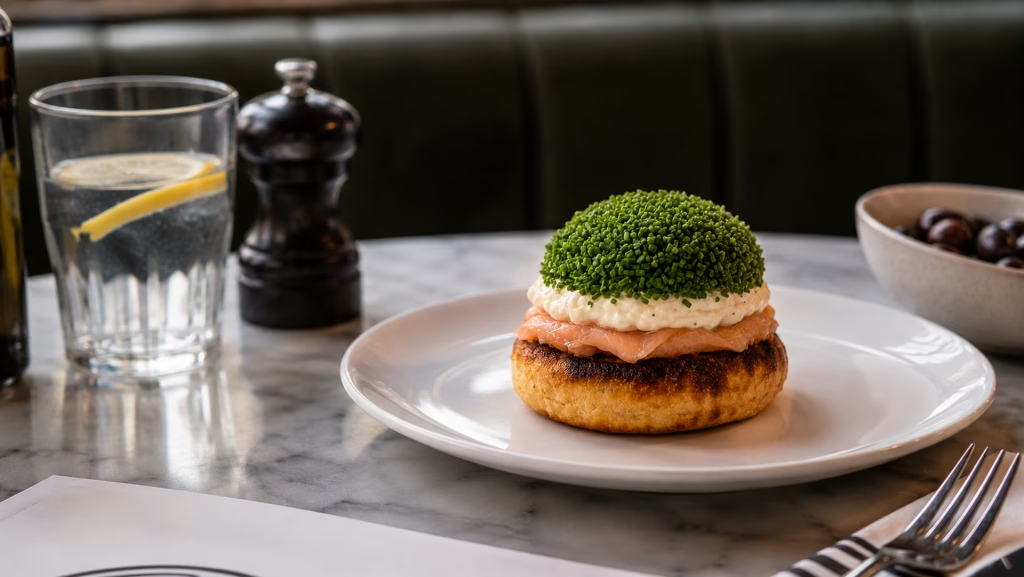
Pizza Express
Pizza Express needed trend-led hero dishes for their Christmas 2024 and September seasonal launches. FIS Group delivered a two-phase innovation sprint from concept ideation through kitchen development to full supplier briefing specifications, with all menu items reaching restaurants nationwide on schedule.
FAQs
Most in-house strategy teams are running at capacity on current commercial work, and most are generalist rather than food and drink-specialist. Our work is project-based, hypothesis-led and run by senior food and drink specialists who can spend the time on the specific strategic question that the internal team cannot afford to take from their standard workload. Often the strongest result comes from commissioning external opportunity mapping alongside in-house strategy, with the two working in parallel rather than in competition. We bring sector specialism and dedicated senior time; you bring internal commercial context the external work cannot replicate.
Two structural differences. First, sector specialism. Food and drink is the only sector we work in, where big four advisory covers every sector. Second, the prioritisation methodology. Big four work is built on generalist strategic frameworks; our prioritisation is anchored in food and drink-specific judgements about brand permission, occasion behaviour, operational reality and competitive position in this sector. The result is a map that reads as commercially credible to people who know food and drink, which matters when the audience for the work is a sector-experienced board or commercial team.
Syndicated opportunity sizing tells you what the market data shows about category penetration, growth and channel performance. Useful, but it is one input rather than the answer. Our work integrates that market data with consumer foresight, occasion logic and category dynamics specific to food and drink, then prioritises across the integrated picture against credibility, brand fit, operational reality and competitive position. The output is a decision-ready map rather than a descriptive sizing report.
That is the question this service exists to answer. The prioritisation is built backwards from the commitment decision, which means every priority opportunity has to be specific enough that the team can act on it (a defined audience, a defined occasion, a defined territory, a defined category, a defined channel) and credible enough that the team can defend the commitment internally. Vague opportunities that fail the specificity test do not make the priority set. We will tell you straight at the scoping stage if your brief is at risk of producing opportunities that are too generic to commit to, and we will recommend tightening the scope before the work starts rather than after.
Opportunity Mapping is about where to play (which audiences, which territories, which occasions, which categories, which channels deserve commitment). Future Food Pipeline Builder is about how to sequence the moves once the strategic direction is locked. The two are complementary tools at different points in the same commercial decision. Most major innovation and growth programmes commission Opportunity Mapping first to lock the strategic direction, then Future Food Pipeline Builder to architect the execution.
Opportunity Mapping works at the strategic level: identifying and prioritising the opportunities worth committing to across the full opportunity universe. Platform and Territory Building goes deep on a single platform: developing it, sizing it, building the proposition, scoping the execution. The two often run together: the mapping identifies the priority platforms, the platform-and-territory work then goes deep on the priority ones one by one.
Ten to fourteen weeks from scoping call to decision-ready readout is the typical window. Compressed timelines are possible where the strategic foundation is already strong (consumer and category decoding in place from Challenge 01 work, internal data accessible, audience and category scope clear). More complex mappings (multi-brand portfolio, multi-market, broader strategic scope) typically run fourteen to twenty weeks. We give realistic timelines at proposal stage.
Carefully, and honestly about the confidence intervals. Sizing emerging opportunities is structurally harder than sizing established ones because the historical data is thinner. We build sizing from a combination of analogue category modelling (what happened in adjacent categories or markets when similar shifts happened), structured consumer behaviour forecasting (how the behavioural shift translates into addressable demand), and operational reality testing (what can credibly be built at what scale). We will tell you straight what level of confidence each sizing estimate carries, and we will not over-claim on emerging opportunities where the data does not support it.
Yes, and this is a common use case. Opportunity mapping work is run regularly for pre-investment and pre-acquisition strategic evidence builds, and is scoped to sit alongside (rather than replace) the financial and operational diligence streams. The work runs under NDA where required. Most M&A and PE buyers commission opportunity mapping as one workstream inside a broader diligence process, often pairing it with QSR Operation Review or sector-specific operational diligence.
Project-based, scoped against the brand or business scope, the strategic decision the work has to support, the geographic coverage, the audience for the deliverable and the depth of prioritisation work required. Single-brand UK mapping is the lowest entry point; multi-brand multi-market portfolio mapping with full activation toolkit is the highest. We give a clear, all-in quote at proposal stage with no hidden extras, and we will tell you straight if your budget will not buy the depth your brief requires.
Got a strategic decision that needs opportunities sized and prioritised for commitment?
Tell us the strategic decision the mapping has to support, the brand or business in scope, the time horizon, the existing strategic work to integrate, and the audience for the deliverable. We will tell you whether opportunity mapping is the right tool, what scope makes sense, what prioritisation dimensions the brief implies and what it will cost. Twenty minutes on a call. No qualifying call before the qualifying call.