

Year Two is open now. Three waves across 2026/27, £9,850 plus VAT for the full programme.
What Appetite Shift is
Appetite Shift is a continuous, industry-wide research programme built around one question: as GLP-1 medications become more common, what happens to how people eat and drink?
It is not a report and it is not a one-off study. The programme runs in waves across the year, with each wave carrying the same architecture so findings stay comparable, and the topic agenda flexing as the picture develops. Between waves, a retained consumer community keeps running, capturing the small everyday decisions that never make it into a survey response.
Four things sit inside it:

Qualitative research that explains the behaviour
A retained community of consumers, plus expert interviews with the people who see this closest: clinicians, nutritionists and operators. This is the layer that tells you why something changed.
Quantitative research that sizes it
Multiple quantitative waves each year, capturing a nationally representative view among 1,000 participants plus deep dives with boosted samples of users and exiters. This is the layer that tells you how things are changing over time, and whether something surfacing in the qualitative work is a signal or a one-off.
A forward view from the United States
Adoption there is further ahead than in the UK and the commercial effects are already visible. We run research in the US alongside the UK work so you can see which behaviours look likely to travel, and roughly when.
An expert innovation view on what to do next
Our innovation team sets out what each wave means for product, format, claim and menu. This is the difference between knowing something has changed and knowing what to build.
Who it is for
Food and drink businesses across the industry: manufacturers, retailers, own label and foodservice. Inside those businesses it is usually insight, innovation, category, marketing and commercial teams, and the outputs are deliberately written so a category manager can act on them without an insight team translating first.
Where it fits, and where it does not
Appetite Shift is the right tool when you need continuous, industry-wide evidence on how GLP-1 driven behaviour is changing food and drink demand, early enough to inform live planning rather than to explain last year. It is not the right tool for everything. If the question is specific to your own products, portfolio or customer base, bespoke qualitative or quantitative work will answer it better. If you need a single one-off read of the category rather than a year of tracking, a focused piece of decoding work is more proportionate. Appetite Shift sits where the question is broad, the change is ongoing, and the value of sharing the cost across the industry outweighs the value of owning the questions outright.

The GLP-1 story was never really about weight loss
Most of the coverage of GLP-1 medications has been about who is taking them and how much weight is coming off. That framing has been useful for the health pages and close to useless for anyone planning a range, a menu or a pipeline, because it describes a population rather than a set of decisions.
Appetite Shift was set up to go after the decisions instead. What is being put in the basket now, and what has quietly stopped going in. Which occasions survived and which ones changed shape. Whether the person who has never taken the medication is behaving differently because someone at their table has. Whether any of it lasts.
Those are commercial questions, not clinical ones, and answering them properly needs primary research in the category rather than inference from prescription data. That is what the programme does, and it is why it runs continuously rather than landing once and going quiet.
What Year One found
Year One ran across the UK through 2025 and 2026, and established the scale of the change. It found genuine attitudinal and behavioural shifts, not marginal ones, and five of them showed up consistently enough to plan against.
-
1. Snacking, eating out and alcohol are being chosen more mindfully
Not abandoned. Chosen. The occasions largely survive, but the volume attached to them and the reasoning behind them have both moved. The commercial consequence is that these categories are being edited rather than exited, which means the decision about what earns its place has become far more competitive.
-
2. Nutrition and function have moved to the front of decision making
When you eat less, every individual choice is scrutinised harder. Protein, fibre and satiety have gone from a claim on the front of pack to the reason a product is picked up at all. That raises the bar on formulation and crowds the claim space at the same time.
-
3. Food-centred rituals are evolving to fulfil new priorities
The table has not emptied. Sunday lunch still happens, the pub round still happens, the birthday meal still happens. What is on the table and in the glass has changed, and so has what people are getting out of the occasion. The ritual is intact and the contents are up for grabs.
-
4. Non-users are mirroring the same behaviours
This is the finding most often missed, and commercially the most significant. People who have never taken the medication are adopting similar habits, picked up from partners, colleagues and friends. It means the addressable change is far wider than the prescription base, and sizing the impact from usage figures alone will understate it.
-
5. Habits are outlasting the medication
People coming off the medication are not simply reverting. Some habits hold, some reverse, and the pattern is not yet predictable. This is the finding with the longest commercial tail and the reason Year Two exists.
The key insight that matters most commercially did not sit in what people stopped eating. It was how joy evolved, in food, in drink and beyond. Food appetite waned. Appetite for life did not.
-
People eating less are not people wanting less. Their reasons for choosing have been rearranged, and the money that used to go on volume is going somewhere. Finding out where is the commercial opportunity.
-
84%
of GLP-1 users eat less food
-
73%
experience fewer cravings
-
71%
describe eating as functional rather than emotional
-
93%
say it is easier to manage weight
-
53%
are less interested in eating out
Where Year Two picks up
Year Two is not Year One repeated with fresh fieldwork. It runs across Autumn 2026, Winter 2026/27 and Spring 2027, and four things change.
Life after the medication
Year One studied people considering, starting, using and exiting the medication. Year Two weights the work towards what happens after, because that is the population growing fastest. We track what appetite looks like once the medication stops: which habits hold, which reverse, what returns first, and whether the reset in food noise survives on its own. This is the single largest unknown facing category planning right now, and it is the main reason Year One partners are continuing.
A read from the United States
Adoption in the United States is further along than in the UK, and the effects on grocery, foodservice and drinks are already visible there in ways they are not visible here. Each wave carries research in the US alongside the UK work. The point is not to import American conclusions wholesale, because the two markets shop and eat differently. The point is to see which behaviours are likely to travel and roughly when, which is the closest thing to a forward view that primary research can honestly offer.
Always-on evidence, not three snapshots
Three waves give the programme structure. A retained community running continuously gives you the micro moments in between: the meal that got skipped, the round that got changed, the product picked up and put back. Behaviour change of this kind is rarely announced in a survey response. It shows up in the small, unglamorous decisions people make when nobody is asking them a question, and the community is there to catch those all year.
Tracking what the industry builds in response
Year Two tracks the salience of GLP-1 inspired products and innovations: what is noticed, what is considered, what is actually used, and why. A great deal of development money is about to be spent in this space and very little of it is currently being spent against evidence of what people are choosing rather than what they say they would choose.
Where Year Two earns its place
Volume and portfolio planning
You are modelling category volume across the next two or three years and need a defensible view on how much of the softening is driven by GLP-1 use, how much is mirroring behaviour among people who have never taken it, and how much is likely to persist once people come off. Year Two gives you tracked evidence across three waves rather than a single point estimate defended in a board meeting.
Innovation pipeline direction
Your pipeline was briefed against an appetite profile that has since moved. Year Two shows which need states are growing, which formats are being chosen and which are being quietly dropped, with the expert innovation view attached so the implications reach your development team rather than stopping with the insight team.
Nutrition and functional positioning
Protein, fibre and satiety claims are crowding fast and the risk of sounding identical to everyone else is real. Year Two tracks which nutritional and functional cues are actually noticed, believed and acted on by people who are eating less, and where the claim space is already saturated.
Eating out and delivery
Eating out has not stopped, but the occasion has changed shape: different party sizes, different courses ordered, different spend split across food and drink. Year Two tracks how those occasions are changing from the consumer side, which is what you need if you are deciding how a menu, a format or a range should respond.
Alcohol and adult drinks
Alcohol is one of the categories most directly affected and one of the hardest to read, because moderation was already well underway before GLP-1 arrived. Year Two separates the drinking that was already declining from the drinking that has changed because of the medication, tracks what is replacing the volume, and reads whether the social occasion is being lost or simply rebuilt around something else.
Range architecture and pack format
Smaller appetite does not automatically mean smaller packs, and several businesses have already found that out the expensive way. Year Two tracks how portion, pack and price interact for people whose consumption has changed, including where reduced volume is quietly funding premiumisation.
Three waves across the year. One evidence architecture.
Year Two runs three waves: Autumn 2026, Winter 2026/27 and Spring 2027. Each wave carries the same architecture so findings stay comparable across the year, with the topic agenda flexing wave by wave as the picture develops. Three layers sit inside every wave
The UK evidence layer
Qualitative and quantitative research running together. On the qualitative side, a retained community of consumers, discussion groups, and expert interviews with clinicians, nutritionists and operators. On the quantitative side, multiple waves capturing a nationally representative view among 1,000 participants plus deep dives with boosted samples of users and exiters. The two are designed against each other rather than commissioned separately and stitched together afterwards.
The always-on community
A retained community running continuously through the year, capturing the micro moments that shape everyday eating and drinking. This is what turns three waves into a continuous read.
The forward view
Research in the United States, plus the expert innovation view. The US work gives you a sightline on behaviours further along the adoption curve. The expert view translates each wave into practical direction on product, format, claim and menu. Between them they answer the question every wave provokes, which is what should we actually do about this.
What you get back
A debrief presentation covering the Year Two insights and their commercial implications at the end of Wave 3, alongside the outputs from each wave as they land through the year.
One price. No add-ons.
The full Year Two programme is £9,850 plus VAT. That covers all three waves, the UK qualitative and quantitative research, the United States work, the always-on community, the expert innovation view and the closing debrief. There is no tiering, no module pricing and nothing held back for an upgrade conversation later.
For syndicated insight of this depth that is exceptional value, and the pricing is deliberate. The programme is worth more to everyone taking part when the partner base is broad enough to represent the whole of food and drink rather than one corner of it.
Sign-up for Year Two closes on 21st August 2026. Signing up before then also means your priorities feed into the Wave 1 agenda, which is set before Autumn fieldwork begins.

Food and drink is all we do
We are not a generalist research agency that picked up GLP-1 because it was in the news. Food and drink is the only sector we work in, and Appetite Shift is run by people who have spent their careers in it: developing products, running categories, testing food with real consumers, and sitting on the other side of the table when the retailer conversation gets difficult.
That matters more than usual here, because GLP-1 started as a health story and has become a food story, and reading it properly takes people who understand the behaviour and the commercial reality it lands in. We put the right team on the work, drawn from strategic insight, innovation and product insight.
We are also, honestly, fascinated by it. This is the most significant change to appetite anyone working in this industry has lived through, and everyone on this programme wanted to be on it. That shows up in the quality of the thinking you get back.

Other ways to stay ahead with continuous insight
Appetite Shift is one of our continuous insight programmes. Depending on what you need to keep track of, one of these may be a better fit, or a stronger partner alongside it.
-
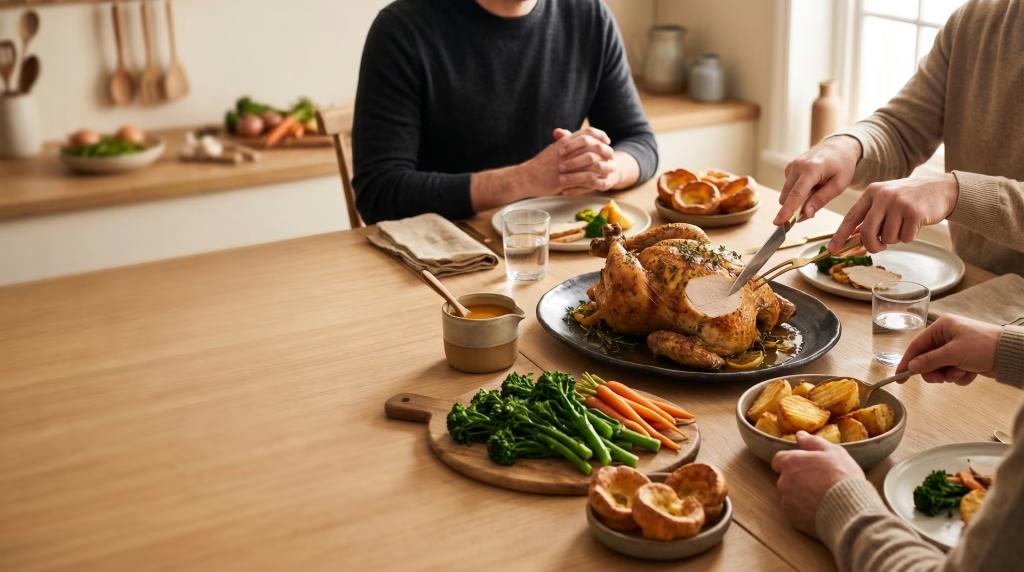
Consumer Closeness Programme
Specialist ongoing consumer closeness for food and drink brands needing sustained connection to consumer reality rather than episodic project immersion.
-

Benchmarking Programmes
Specialist benchmarking programmes for food and drink brands needing ongoing competitive context across brand performance, innovation pipeline, consumer perception, channel dynamics and operational reality.
-
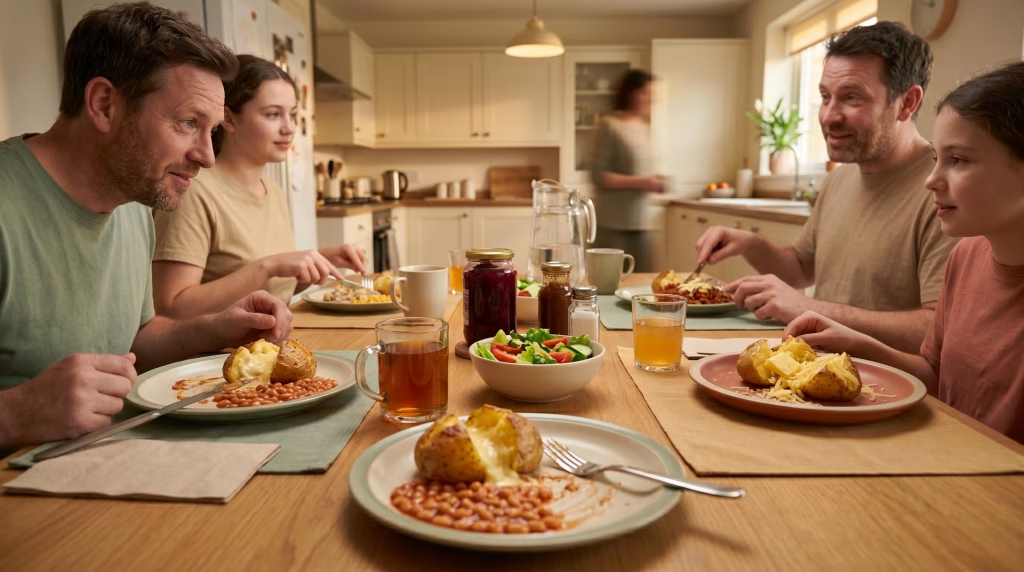
Meal Tracking
Specialist meal tracking for food and drink brands needing ongoing evidence of consumer eating behaviour across meals, occasions, dayparts and contexts

View our case studies
-

Oscar Mayer
Oscar Mayer needed category understanding in convenience and discount channels that could drive retailer conversations. FIS Group delivered a multi-phase programme combining quantitative, qualitative and innovation expertise, turning research into a commercial asset at the negotiating table.
-

Burger King
Burger King needed in-depth consumer testing of two new burger builds across multiple variants before launch. FIS Group delivered a real-store central location test with penalty analysis and innovation expert input, providing precise optimisation insight and benchmarks to inform future menu development.
-
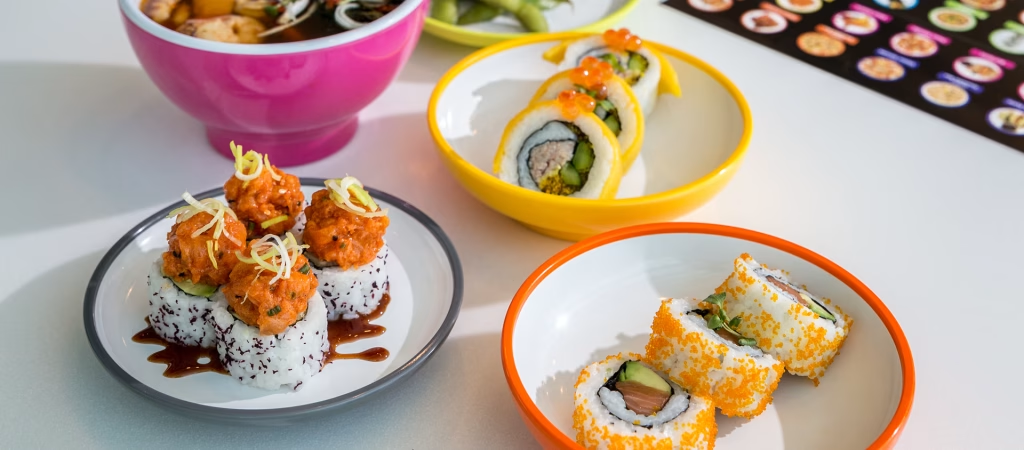
YO!
YO! needed to understand customers across three channels while balancing growth with brand loyalty. FIS Group combined quantitative survey work with agile listening groups to shape twelve months of marketing decisions.
FAQs
Appetite Shift is a syndicated research programme from FIS Group tracking how GLP-1 medications are changing the way people in the UK eat, drink, shop and choose. It runs continuously, in waves across the year, combining qualitative research, multiple quantitative waves, research in the United States and an always-on consumer community, with an expert innovation view on what each wave means commercially. Because the programme is syndicated, the cost is shared across the food and drink businesses taking part.
No. Year Two is a standalone programme. New partners receive a summary of the Year One findings when they join, so the Year Two waves make sense in context from the first debrief. Continuing partners get the added benefit of tracked comparison across both years.
All three waves across Autumn 2026, Winter 2026/27 and Spring 2027. Within each wave: UK qualitative research through a retained community of consumers, discussion groups and expert interviews; UK quantitative research capturing a nationally representative view among 1,000 participants plus deep dives with boosted samples of users and exiters; research in the United States; and the expert innovation view on what to do next. Access to the always-on community runs throughout the year. A debrief presentation covering the Year Two insights and their implications lands at the end of Wave 3.
Insight, innovation, category, marketing and commercial teams. The outputs are deliberately written so a category manager can act on them without an insight team translating first. Most partners circulate the wave outputs across several functions rather than keeping them inside one.
Cost and breadth. Bespoke work answers questions specific to your products and your customers, and there are briefs where that is the only sensible route. Appetite Shift answers the industry-wide questions that every food and drink business is currently asking and that none of them should individually be paying full price to answer. Plenty of partners run both, using Appetite Shift for the landscape and bespoke work for their own portfolio.
Because adoption there is further ahead and the commercial effects are already visible in ways they are not yet visible here. The US work is a sightline rather than a forecast. We use it to flag which behaviours look likely to travel, so UK planning can be made earlier and with more confidence.
Yes. Signing up before 21st August 2026 means your priorities feed into the Wave 1 agenda, which is set before Autumn fieldwork begins. The topic agenda then flexes across the year based on what the community and the earlier waves surface, and partner priorities feed into that too. The programme is syndicated rather than bespoke, so the questions stay industry-wide.
Sign up before 21st August 2026 and your priorities feed into the Wave 1 agenda.
Tell us the categories you operate in, the decisions this evidence has to inform, and the planning timings you are working to. We will confirm what Year Two covers, how it sits alongside anything you already run, and what signing up involves. If Appetite Shift is not the right answer to your question, we will say so and point you at what is.
Speak to Emma Wood, Group Commercial Director.