
I spent a good part of my career working alongside brilliant potato and cereal growers. I built brands, launched innovation and worked with supply chains to secure the most sustainable supply contracts for bagged snacks, ready to eat cereals and porridge.
One thing you learn quickly is that a grower’s year is not an average of anything. It is a run of specific weeks that either go the right way or do not, and the ones that matter most are usually the ones nobody outside the farm is paying attention to.
This year a lot of those weeks went the wrong way.
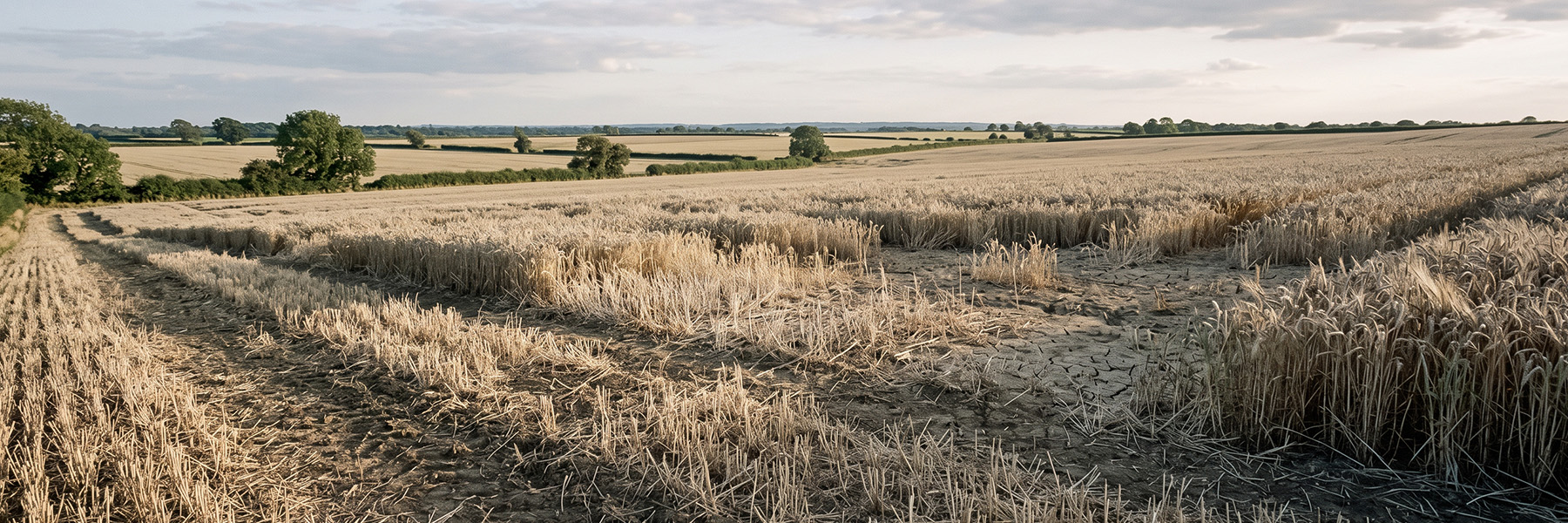
Oats have come in at a 46 year low. Wheat is 13% below its five year average, and that figure has not improved as the harvest moved north. Combined cereals and oilseeds look likely to produce the smallest harvest since detailed records began in 1984. A commercial potato crop needs somewhere around 350 millimetres of water across its growing season, and in the week to the twelfth of August there were more than 1,500 abstraction licence restrictions in place.
England has now had major droughts in 2022, 2025 and 2026. Fifteen MPs put it well in a letter to government this month. What once appeared exceptional is rapidly becoming part of our national experience.
At some point a run of exceptional years stops being a run of exceptions.
This is a planning question first
Almost everything in a food business is built on an assumption of predictability. Range architecture, specification, promotional calendars, supplier contracts, forecast models. All of it assumes that most years look roughly like most other years, with the occasional bad one to be absorbed.
The last five years have not supported that assumption. Which makes this worth looking at again, not as a weather story but as a planning one.
Three assumptions worth revisiting
That a domestic supply base spreads the risk. The instinct is that sourcing close to home reduces exposure, and for a long time it did. This year has inverted that for one category, and it is worth being precise about why. It is not that British growing is weaker. British growers have had an extraordinarily difficult season and have handled it with a great deal of skill. It is that a single weather system can reach every domestic field at once. Salad has been steadier this summer precisely because it is spread across more geographies. The issue is concentration rather than country, and concentration is something a buyer can do something about.
That Europe is the backstop. The usual release valve is to buy the shortfall from the Netherlands, Belgium, Germany or Poland. Mainland Europe has had its own heatwaves and dry weather this summer, and water levels on the Rhine and the Danube have fallen far enough to disrupt freight. A backstop that fails in the same weather as the thing it is backing up is a correlated risk rather than a backstop, and it needs planning for as one.
That this is only a crops problem. This is the one I would push hardest. Arable and horticulture have had the coverage, and the protein and dairy picture may turn out to be the bigger story. Grass growth fell 46% below average at the end of July, and livestock producers are into winter forage months earlier than planned. It is the second short forage year running. The consequences of that land next year rather than this one, in animal size, in carcass quality, in milk volume and in input costs. Anyone whose exposure assessment stopped at the vegetable aisle has assessed about half of it.
What growers are already doing about it
It would be easy to write this as though the industry is standing still. It is not, and the investment going into water resilience deserves more attention than it gets.
British Berry Growers reports that 61% of its growers have already put in on farm reservoirs or rainwater storage. Every grower surveyed has a water efficiency plan, and 65% have cut water use by an average of 16% over three years. That is years of quiet capital investment by businesses that are rarely credited for it.
It is also slow and expensive to do. The Country Land and Business Association puts the average cost of getting permission for a reservoir, before any construction starts, at around 45,000 pounds. Government has reopened the Water Management Grant with up to 15 million pounds for on farm storage and is updating planning guidance in September, which should help.
There is a commercial point buried in this that I think is being missed. If you buy fresh produce, you should know which of your growers has water storage and which does not. That single fact will tell you more about who delivers to specification next summer than almost anything else in a supplier review.
What actually changes
Not very much, if the conclusion is to buy more carefully. Quite a lot, if the conclusion is that variability is now a design input rather than an exception to be managed.
Specification becomes a lever rather than a constraint. Most specifications in fresh produce were set years ago and copied forward since. In a stable climate that is efficient. In a volatile one it means turning away good food on rules nobody has revisited. The businesses that hold availability this winter will be the ones that already know how far they can move on size and appearance before shoppers notice.
Ranges get planned around variability rather than around a forecast. Knowing your substitutions in advance. Understanding which products people will accept in place of which. Having the pack formats ready in September rather than designing them in November.
The one development I would keep an eye on
Precision breeding. The regulations came into force in England in November last year and the first commercial applications are already in the system. The prospect is crops that need less water, resist disease better and hold yield through a summer like this one.
The open question is not a scientific one. It is a consumer one, and it is serious. Nobody in this industry wants a repeat of how genetic modification was received in the nineties. The difference between a technology being understood as a sensible response to a water shortage and being understood as something done to food is largely a matter of language and timing. That is a question you can put to people now, rather than finding out the answer after launch.
Where I would start
Not with a strategy. With a number.
Work out how much of your volume is exposed to a repeat of this summer, and how much of that exposure is genuinely about supply as opposed to specification you control. In my experience businesses are consistently surprised by how much sits in the second category. It is also the category you can still do something about between now and Christmas.
This year is not an anomaly to be survived. It is the best rehearsal anyone is going to get.
FIS Group works with food and drink businesses across the product lifecycle, from innovation and research through to consumer testing and in market optimisation. To talk through where your portfolio is exposed and what is worth testing before Christmas ranging is locked, message me directly or contact Dave Hughes.