
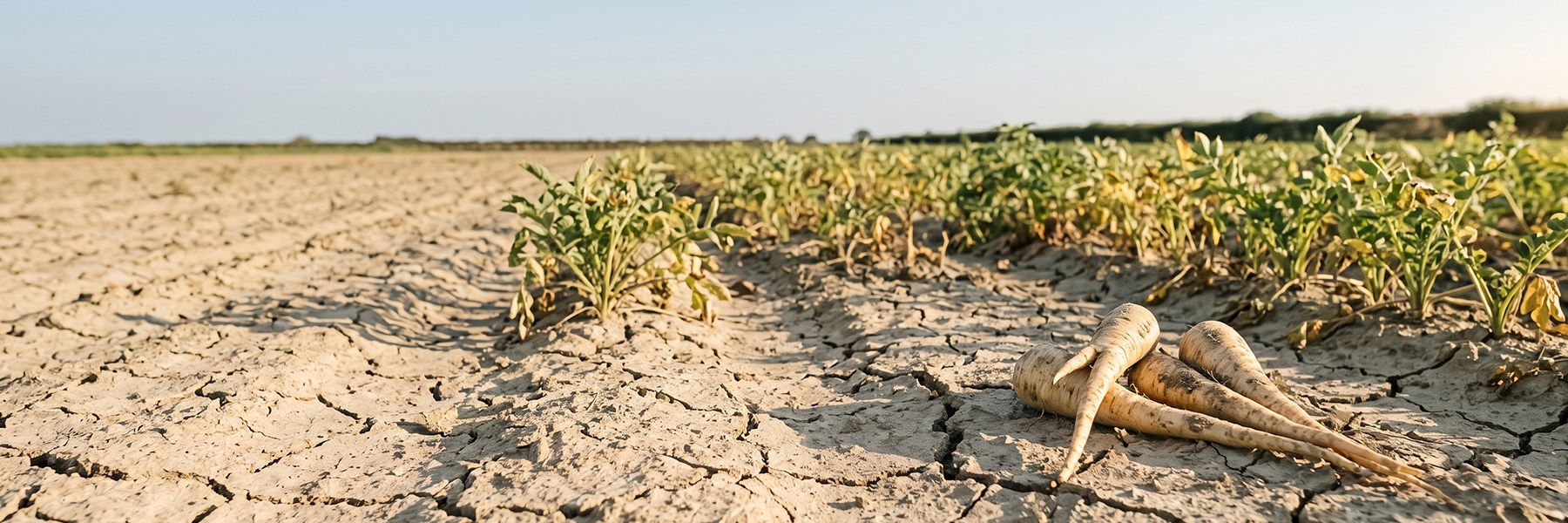
The drought gripping England this summer will reach the Christmas vegetables on shelf in December, and how badly is being decided right now, in fields that have had almost no water since spring.
England has just had its driest July since records began in 1836. Just 6.5mm of rain fell, a tenth of the long term average and less than half the previous record set in 1911. Rainfall ranged from 1 per cent of the expected average in the south east to 26 per cent in the north west, and parts of Hampshire, the Isle of Wight and West Sussex went 59 days without a rain day. By the tenth of August, 71.3 per cent of England was officially in drought. It is the third in five years, after 2022 and 2025.
Most people in food have read that part already. The more useful question is what it does to the crop that has not been lifted yet.
What the harvest is saying
AHDB’s second harvest report of the season gives the clearest answer so far, and it is not a comfortable one. With 85 per cent of the wheat area cut, average yields remain 13 per cent below the five year average, unchanged from the first report. Only 10 per cent of the farms surveyed beat their own five year average. Analysis by the Energy and Climate Intelligence Unit puts combined cereals and oilseeds at about 19.5 million tonnes, which would make it the smallest harvest since detailed records began in 1984, and as much as 390 million pounds in lost revenue for arable businesses.
The number that tells you most is not the average. It is the spread. Reported wheat yields ranged from 3.9 to 11.5 tonnes per hectare. Same country, same summer, same crop, and nearly three times the yield between one farm and another.
And not everything is down. Oilseed rape has had a good year, at 3.9 tonnes per hectare against a ten year average of 3.3.
“That variation is the story, not the average,” says Moxon. “Two growers with the same contract and the same specification can be in completely different positions this year depending on soil type, water access and when they drilled. If you are buying on a national number you are going to be surprised by what actually turns up.”
Why Christmas vegetables are a separate problem
Salad crops are heavily imported and always have been. The Christmas vegetables people expect are not. Potatoes, sprouts and parsnips are largely home grown, which means they carry the full weight of a British drought with no import habit to fall back on.
The timing works against us too. The potatoes usually eaten at Christmas go in during April and May and come out in September and October. They have spent their entire bulking period in this weather.
What water stress does to a root crop is specific, and it is worth being precise about it. It does not usually produce an empty field. It produces smaller, forked and misshapen roots. The field is still there. The saleable crop inside it is smaller.
“That distinction is where the commercial pain sits,” says Moxon. “A 20 per cent yield loss is a supply conversation. A 20 per cent specification failure is a different conversation entirely, because the food exists, it is in the shed, and the only thing stopping it reaching a plate is a rule somebody wrote when the weather was more predictable.”
There are second order effects as well. Parsnips sweeten in cold weather as starches convert to sugars, so this year flavour is in play alongside size and shape. Some broccoli growers are reporting yields halved and packing two heads together to make the weight the pack is sold in. Carrot growers warn that domestic supply could run out a couple of months early in spring, pulling imports forward into a market where everyone wants the same thing.
What it means for Christmas vegetables between now and December
Not empty shelves. That is worth saying plainly, because the alternative headline writes itself and it is not what the people closest to the crop are saying. What it means for Christmas vegetables is four things at once: less crop, more of it failing specification, greater variability between growers and regions, and upward pressure on price.
Some of that is already visible in wholesale. Potatoes are up more than 40 per cent, iceberg lettuce 90 per cent and tomatoes more than 60 per cent.
The usual release valve is Europe, and this year it is less available than normal. Mainland Europe is dealing with its own heatwaves and dry weather, and water levels on the Rhine and the Danube have fallen far enough to disrupt freight and energy generation. A backstop that fails in the same weather is not much of a backstop.
What a business can actually do?
Three things, and all of them are easier in August than they will be in November.
Ask growers a better question. Not whether there will be enough. The useful question is what percentage of the contracted crop will actually meet the Christmas specification. Those are different numbers and only one of them is a plan.
Find out what consumers will genuinely accept. Almost every business is going to widen specification this year. Most will do it in November, under pressure, using an internal judgement about what shoppers will tolerate. That judgement is usually inherited rather than tested.
Decide early. By November most of the physical supply position is fixed. What is still open is what you choose to sell, how you pack it and how you describe it.
“Specification is a commercial decision that has been dressed up as a technical one for about thirty years,” says Moxon. “Somebody decided a long time ago what size a parsnip should be, and it has been copied forward ever since. Nobody has been back to consumers recently to check whether they care, and in a year like this that gap is worth real money. We can answer it in a matter of weeks, and the answer holds for every season after this one.”
The point
The Christmas vegetables that appear on shelf in four months are being determined right now by rainfall nobody controls and by specification decisions that plenty of people do control. The first of those is weather. The second is a choice, and it is one that responds well to evidence.
Fresh Produce Testing helps food businesses understand how produce is experienced by consumers, and what they will and will not accept on size, shape, appearance and eating quality. To talk through what that means for your Christmas vegetables before ranging is locked, contact Chris Moxon.