
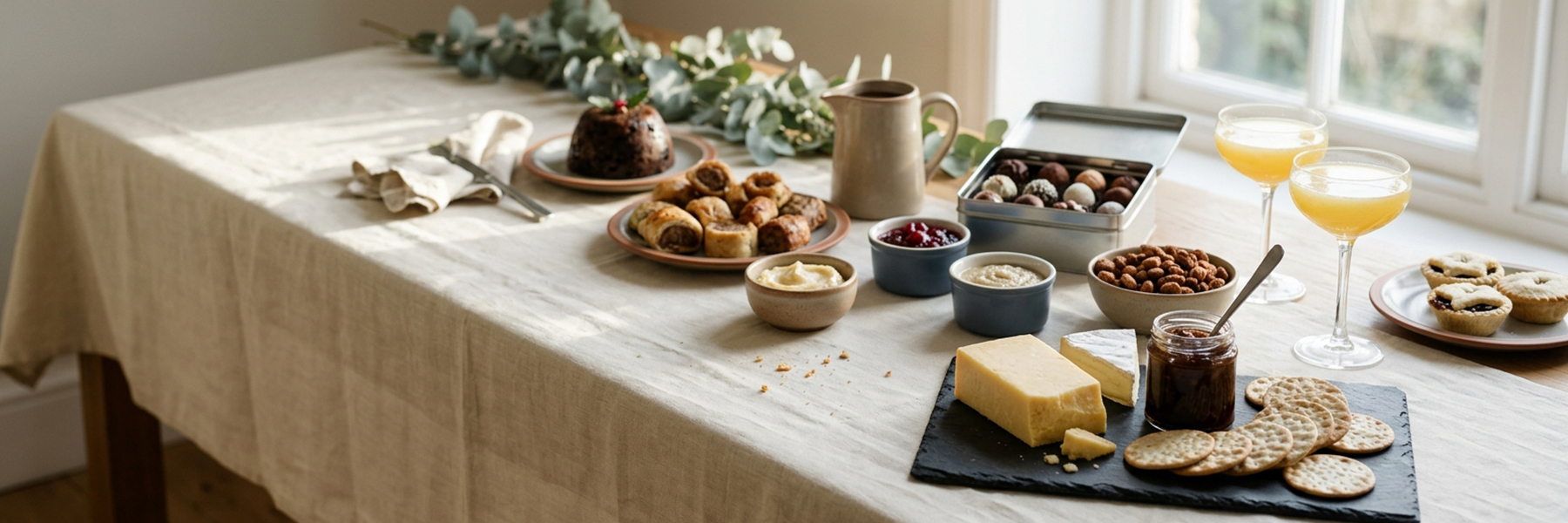
Ask somebody about brandy butter in April and you will get a shrug. Ask them in the second week of December and you will get an opinion, a brand they always buy, a story about the year somebody bought the wrong one, and a view on whether it should go on the pudding or the mince pies.
That is the whole argument, and it applies to every product that only exists because of Christmas.
“For about eight weeks a year, people are genuinely thinking about Christmas food,” says Chris. “They are planning it, shopping for it, arguing about it and cooking it. That is when their reactions mean something. The rest of the year you are asking them to imagine, and imagined Christmas is a very different place from the real one.”
It is not only the turkey and the sprouts
When people talk about testing for Christmas they tend to mean the centrepiece and the vegetables. The range is far wider than that, and most of it gets less attention than it deserves.
Cheese boards and the chutneys that go with them. Brandy butter, cream and custard. The buffet: sausage rolls, party food, canapes, the things that come out on Boxing Day. Appetisers and starters. Christmas puddings, cakes, mince pies and the alternatives for the people who do not like any of those. Gravies, bread sauce, cranberry sauce and the whole condiment shelf. Bucks Fizz, mulled wine, the sparkling wine that gets opened at eleven in the morning. Chocolates, coated nuts, tins of biscuits, the things that get bought to have in.
Every one of those is chosen in a particular frame of mind, against a tradition, with a budget under pressure, and often by somebody who does not buy that category at any other time of year. A hall test in May tells you almost nothing about how a new cheese board lands in December. Christmas range testing has to cover all of it, in the season.
What the season lets you see
Four things that a test outside the season cannot give you.
The whole shop, not the single product. In December you can see how a product performs alongside everything else competing for the same table, the same fridge and the same oven. A pudding tested on its own is tested in a situation that never occurs.
Genuine trade offs. Christmas is a high pressure shop. Last December the average household spent £476 at the supermarkets, and a third of all grocery spending went on promotions, the highest share since before the pandemic. At the same time premium own label took a record share. People trade up and trade down inside the same basket, and the only way to find out which way a given product goes is to watch it happen.
Tradition, and whether it will bend. Some Christmas products fail because they are not good. Others fail because they are fine but they are not what Christmas is supposed to look like. Those two failures look identical in a spreadsheet and completely different in a kitchen. Only the season tells you whether a new idea has to work with the tradition or can break it.
Whether you can actually deliver it. Testing in the real season means testing the system, not just the appeal. Specification, pack format, forecasting, merchandising. A product that people love and the supply chain cannot deliver at volume is a more expensive discovery next September than it is now.
Why what you learn this year matters for next year
Supermarket Christmas planning starts a long way out. Industry reporting puts it at around eighteen months to two years ahead, with one major retailer holding its Christmas workshop roughly twenty months before the day. Ambient and frozen lines are briefed to suppliers first. Chilled follows. Fresh arrives in store last.
Which means the Christmas 2027 range is being shaped now, and this Christmas is the only live one available to learn from before those decisions are made.
“If you assume next year looks like this year, you are making a bet with the range,” says Chris. “The businesses that come out of this well will be the ones that treated this Christmas as a rehearsal and took proper notes.”
The sequence is simple once the timing is right. Test this winter. Design in spring. Secure supply in summer. Scale in autumn. Sell it next Christmas. Skip the first step and every subsequent one is built on a guess.
And for fresh produce, this year in particular
One part of the Christmas range has an extra reason to be tested this year, and it is worth saying plainly.
England had its driest July since records began in 1836, and by August 71.3% of the country was in drought, the third in five years. Water stress in a root crop does not empty a field. It makes the roots smaller and less uniform. Potatoes, sprouts and parsnips are largely home grown, so this Christmas they will be smaller and more variable than usual, and every retailer has a plan B built on this year’s yields, which for many lines means imports.
“For once, imperfect produce is going to be on shelf at the real moment, in front of real shoppers,” says Chris. “You can watch what people actually accept when the sprouts are smaller, whether they move to frozen, whether they mind that it is imported. Nobody has to imagine anything. That is a test environment you cannot buy in a normal year.”
Fresh produce also has the longest lead time of anything on the table, because it has to be grown. A sprout on the Christmas 2027 table is sown in spring 2027, with the acreage and the contract agreed before that. And with the Met Office projecting drier summers, next year cannot be assumed to look like a normal year either.
The Christmas range testing window
Christmas range testing runs from October to December, while people are in the mindset and the products are on shelf. It is the one part of the year when a reaction to a mince pie, a cheese board or a bottle of Bucks Fizz is a real reaction rather than a polite guess.
After that it closes for a year, and the next chance to find out is after the decisions have been made.
FIS Group tests Christmas ranges in the season, with the people who buy them, across everything from the centrepiece to the cheese board. To talk through a Christmas range testing programme for October to December, contact Chris Moxon.