

When the launch commitment depends on the volume projection being defensible
Most major launches commit to volume projections that the underlying forecasting could not defend. The innovation director needs a number for the commercial case; the commercial director needs a number for the retailer commitment; the supply chain director needs a number for capacity planning; the finance director needs a number for the P&L impact projection. The internal forecasting team produces a number against the timeline and the commercial team commits against it. Six months post-launch, the actual volumes are materially different from the forecast in ways that compromise the commercial commitments made against it.
The structural problem is that most internal forecasting handles new launches the way it handles existing range projections, with category dynamics and consumer evidence treated as input alongside other inputs rather than as the foundation of the projection. New launch forecasting needs different methodology: integration of consumer evidence (concept test scores, product test performance, market dynamics) into volume projections, channel-specific calibration (FMCG, foodservice, e-commerce dynamics vary materially), scenario forecasting where uncertainty matters more than a single point projection, and senior interpretation of what the forecast actually supports for commercial commitment.
Volumetrics is the specialist volume forecasting methodology for food and drink new product, range and menu launches. The work brings together volumetric specialists (who build the forecasting methodology), insight specialists (who integrate consumer evidence and category dynamics), commercial specialists (who calibrate against channel reality), and senior food and drink interpretation throughout. Output is decision-grade volume projections that the commercial team can commit against, with the uncertainty handled honestly and the forecast assumptions transparent for the commercial committee scrutiny that always follows.
It is not the right tool for every brief. If the brief is existing range volume planning rather than new launch forecasting, internal commercial planning is more proportionate. If the brief is general market sizing rather than launch-specific volume projection, broader market research services are structurally different. If the brief is simple back-of-envelope estimation for early-stage concepts, our broader insight services may provide what is needed at proportionate scale. Volumetrics sits specifically when the brief is decision-grade volume forecasting for launches where the commercial commitment depends on the projection being defensible.

What we do differently
-
Consumer evidence integrated into volume projection methodology
The structural difference between Volumetrics and generic forecasting. Most volumetric forecasting treats consumer evidence as input alongside other inputs; our methodology builds consumer evidence into the foundation of the projection: concept test performance translates into trial projection logic, product test performance translates into repeat purchase projection, consumer evidence on cannibalisation translates into range impact projection. The integration is what makes the forecast defensible against commercial committee scrutiny because the volume projection has consumer evidence behind it rather than just internal assumption.
-
Channel-specific calibration for food and drink reality
The sector specialism. Volume forecasting varies materially by channel in food and drink: FMCG retail follows category dynamics (range positioning, retailer distribution, promotional mix); foodservice follows operator dynamics (operator type, daypart, menu integration, channel-specific consumer behaviour); e-commerce follows digital dynamics (discoverability, conversion, basket integration). Our methodology calibrates against the specific channel reality rather than applying generic forecasting across channels. The calibration is what makes the forecast credible against the actual launch context rather than generically correct but commercially uninformative.
-
Scenario forecasting that handles uncertainty honestly
The methodological honesty. New launch forecasting carries genuine uncertainty (consumer response to genuinely new products is unpredictable, market dynamics shift, competitive response varies). Single-point forecasts pretend the uncertainty does not exist; scenario forecasting handles it honestly. Our methodology produces scenario ranges (base case, optimistic, conservative) with the underlying assumptions transparent and the sensitivity drivers identified. The commercial team commits against scenarios rather than against false-precision point forecasts, which is what makes the forecast useful for risk-aware commercial decision-making.
-
Senior interpretation that translates forecasts into commercial direction
The interpretive layer. A forecast number is informative; the interpretation of what the forecast supports for commercial decisions is what makes it actionable. Senior food and drink specialists interpret the volume projection against the commercial context: what the forecast supports for retailer commitment, what it implies for capacity planning, where the upside opportunities sit, what the downside scenarios mean for risk planning. The interpretation is what makes Volumetrics useful for commercial decision-making rather than just informative for analytical consumption.
Six commercial use cases, written as scenarios a buyer will recognise from their own brief. The aim is for the reader to see their question on this list and self-select.
New product launch volume projection
You are launching a new product and need decision-grade volume projection to inform commercial commitments (retailer listing volume commitments, P&L projections, capacity planning, marketing investment). Volumetrics integrates consumer evidence (concept test scores, product test performance), category dynamics, channel reality and senior interpretation into a defensible volume projection scoped for the specific commercial decisions the forecast has to support.
Range launch volume and cannibalisation projection
You are launching a range and need both the new volume projection and the cannibalisation impact projection on the existing range. Volumetrics handles the integrated forecast: which new SKUs deliver what new volume, how much new volume is genuinely incremental versus cannibalised from existing range, what the net range impact is across the launch period. Critical for range strategy decisions where the commercial case depends on the cannibalisation reality.
Menu programme volume projection
You are launching a foodservice menu programme and need volume projection scoped against operator dynamics: which menu items deliver what volume, what the menu engagement looks like, how operational reality affects volume realisation, what the daypart and channel-specific volume dynamics are. The foodservice equivalent of FMCG volume forecasting, with the methodology calibrated for foodservice operational reality and operator commercial dynamics.
Scale-up brand growth trajectory forecasting
You are a scale-up brand commissioning growth trajectory forecasting that supports investment cases, board commitments or strategic planning. Volumetrics produces growth trajectory projections grounded in consumer evidence and category reality rather than internal optimism, with the scenario ranges scoped for the strategic decisions the forecasting has to support (investor commitments, strategic partnership conversations, board strategic planning).
International market entry volume projection
You are entering a new market (UK brand entering Europe or US, international brand entering UK) and need volume projection for the market entry launch: market sizing, channel dynamics, consumer reception projection. Volumetrics handles the international launch projection with methodology calibrated for the specific market reality rather than assuming UK or domestic dynamics extend. Critical for market entry investment decisions where the forecast supports substantial commercial commitments.
Capacity planning forecast for 3PM and manufacturing
You are scoping manufacturing capacity for launch (3PM commercial commitments, in-house capacity planning, contract minimums) and need volume forecasts the capacity planning can commit against. Volumetrics provides the forecast layer that feeds capacity planning, often commissioned alongside 3PM Manufacturing Solutions for major launches where capacity decisions are commercially sensitive. The integration of volumetric forecasting with capacity planning is what makes the manufacturing commitments defensible rather than over-built or under-built.
-
How a Volumetrics project runs
From launch context to defensible volume projection
-
Scoping call
Twenty minutes on a call. You tell us the launch context (which products, which channels, which markets, what the commercial commitments are), the existing consumer evidence available (concept testing, product testing, market research, internal sales data), the decisions the forecast has to support (retailer commitments, P&L projections, capacity planning, investment cases), the integration with your internal forecasting and commercial team and the timeline. We tell you whether Volumetrics is the right tool, what format makes sense, what evidence integration is feasible and roughly what it will cost. Where the brief would be better served by internal forecasting with selective external support, by market sizing rather than launch forecasting, or by other approaches, we will recommend the right alternative honestly.
-
Evidence audit and methodology design
Senior team audits the existing consumer evidence and identifies the integration points for the forecast: how concept test performance translates into trial projection logic, how product test performance translates into repeat projection, how market dynamics inform category share assumptions, where the forecast methodology has to flex for channel-specific reality. Methodology designed against the specific brief and signed off by the client before forecasting work opens, so the forecast is scoped against agreed parameters rather than against generic forecasting methodology.
-
Forecasting work
Volumetric specialists run the forecasting work against the agreed methodology: trial projection from consumer evidence, repeat projection from product performance, channel-specific calibration, range cannibalisation modelling where relevant, scenario development across base case, optimistic and conservative scenarios. The work integrates the consumer evidence and category dynamics throughout rather than treating them as input applied at the end of methodology execution.
-
Scenario development and senior interpretation
Senior food and drink specialists develop the scenario ranges and run the interpretive layer: what the base case forecast supports for commercial commitment, what the optimistic scenario implies for upside planning, what the conservative scenario means for downside risk planning, where the sensitivity drivers sit (which assumptions matter most for the forecast outcome), what the forecast genuinely supports versus over-claims on. The interpretation is what makes the forecast commercially useful rather than just numerically present.
-
Decision-ready volume projection
A working readout session walking the team through the volume projection, the scenarios and the commercial implications, followed by the full deliverable: scenario forecasts with transparent assumptions, sensitivity analysis on the key drivers, commercial decision support recommendations against the specific decisions the forecast has to inform, integration with capacity planning or 3PM Manufacturing work where relevant. The deliverable is built for the commercial decision audience (board, investment committee, commercial committee, NPD committee) and lands within three weeks of fieldwork completion for focused briefs, longer for strategic forecasts.
Three formats. Scoped against the launch context and the forecast commercial purpose.
Volumetrics flexes against the launch context, the forecast scope and the commercial decisions the forecast has to support. The three formats below are the typical engagement shapes, with the format selected at scoping rather than assumed. Focused launch forecasting for single product or focused range work; strategic launch forecasting for range or multi-channel work; pipeline forecasting for ongoing projection across multiple connected launches.
Focused launch forecasting
Single product or focused range, single market, single primary channel, typically four to six weeks from scoping to decision-ready forecast. Cross-functional team scoped to the focused brief; evidence integration tightly scoped against the specific launch context; output focused on the commercial decisions the forecast has to inform. The most common Volumetrics format and the cleanest commercial proposition for focused launch forecasting briefs.

Strategic launch forecasting
Range launch, multi-channel scope, or major strategic launch context, typically six to ten weeks from scoping to decision-ready forecast. Cross-functional team scoped for the multi-dimensional complexity; integrated forecasting across the range or channel scope with cannibalisation modelling where relevant; output scoped for the strategic commercial decisions the forecast has to inform. Suited to substantial commercial commitments where the strategic forecasting complexity exceeds focused single-product work.

Pipeline forecasting
Ongoing forecasting across multiple connected launches in a strategic innovation pipeline, typically running across six to twelve months or longer as a sustained engagement. Cross-functional team scoped for ongoing pipeline integration; forecasting methodology flexes across launches within the pipeline; senior team holds the cumulative pipeline context across the engagement. Suited to strategic innovation contexts where the pipeline coherence affects forecast assumptions and where individual launches gain forecasting accuracy from the pipeline integration.

Food and drink is all we do
We are not a generalist forecasting consultancy that takes the occasional food and drink brief or an analytics consultancy that adds volumetric work on top of broader services. Food and drink is the only sector we work in, and our senior team runs volumetric forecasting for this sector specifically: knowing which consumer evidence types correlate with which volume outcomes in food and drink, knowing the realistic forecast ranges by category, knowing where the forecasting needs to flex against channel-specific reality. Generic forecasting consultancies can run forecasting methodology; sector specialists can run forecasting calibrated against food and drink commercial reality rather than against generic category assumptions.
That focus is why we work with 11 of the UK’s top 40 food and drink brands.
Other ways to launch and scale innovation successfully
Volumetrics is one tool in the broader Launch & Scale Innovation Successfully toolkit. Depending on the brief, one of these might be a better fit, or a stronger partner alongside the volumetric forecasting work.
-

3PM Manufacturing Solutions
Manufacturing partner support for food and drink businesses. Supplier mapping, specification, trials and scaling production. We do not own manufacturing or place orders.
-

Product Testing (IHUT, CLTs, in-restaurant)
Specialist consumer product testing for food and drink innovation.
-

REVU
Specialist post-launch optimisation for food and drink brands. Integrated post-launch evidence (sales data, consumer feedback, operational performance, market dynamics) with senior food and drink interpretation throughout.

View our case studies
-

Biotiful Gut Health
Biotiful Gut Health needed three potential ambient territories validated before committing development resource. FIS Group investigated and defined each territory, developed concept iterations, ran quantitative consumer testing and built a DVF prioritisation model – giving Biotiful a clear, evidence-based view of where to focus first.
-
Mars
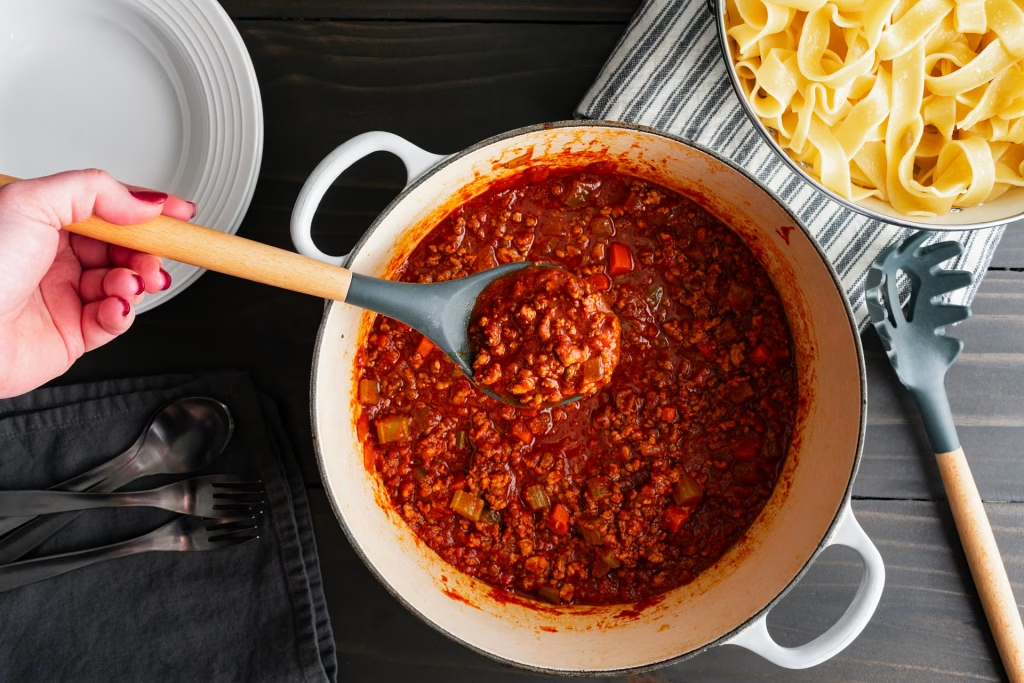
Mars needed a true research partner to decode consumer meal behaviour across three markets. FIS Group delivered a bespoke Meal Moments programme combining in-the-moment diary capture, qualitative exploration and strategic workshop facilitation – turning occasion-level data into immediate commercial direction.
-
YO!
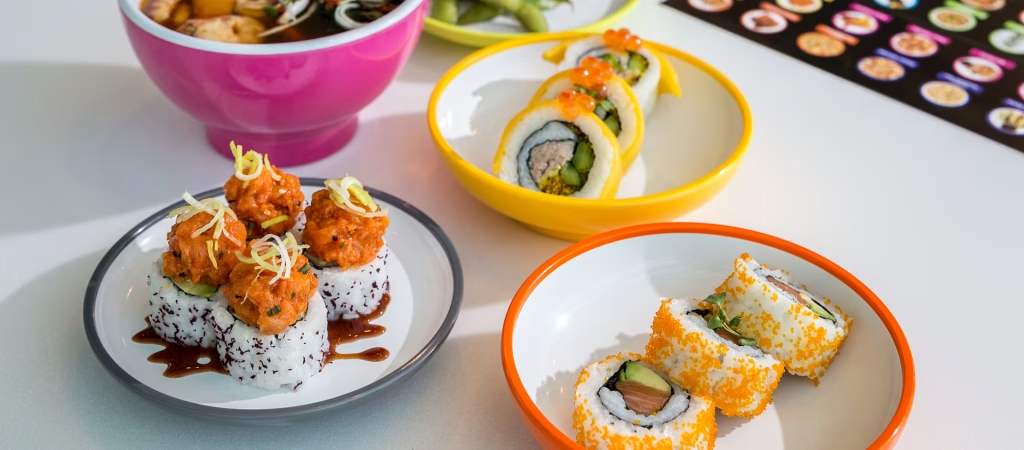
YO! needed to understand customers across three channels while balancing growth with brand loyalty. FIS Group combined quantitative survey work with agile listening groups to shape twelve months of marketing decisions.
FAQs
Volume forecasting for new launches carries genuine uncertainty that no methodology can eliminate completely. Our methodology aims for decision-grade accuracy: forecast ranges that the commercial decision can commit against credibly, with the uncertainty handled honestly through scenario ranges rather than false-precision point forecasts. Realistic accuracy varies by launch context: focused new product launches in mature categories with strong consumer evidence typically forecast within ten to twenty per cent of actual volume at twelve months; novel category launches, scale-up trajectories or international market entries carry wider scenario ranges because the underlying uncertainty is genuinely higher. We will be honest at scoping about the realistic accuracy the methodology can support for your specific launch context, and we will not over-claim on forecast precision.
Three structural differences. First, consumer evidence integration: internal forecasting typically treats consumer evidence as input alongside other inputs; our methodology builds consumer evidence into the foundation of the projection. Second, channel-specific calibration for food and drink: internal forecasting often uses methodology calibrated for existing range planning; new launch forecasting needs different methodology calibrated for launch-specific channel dynamics. Third, scenario forecasting and senior interpretation: internal forecasting often produces single-point projections; our methodology produces scenario ranges with senior food and drink interpretation translating the forecast into commercial direction. For routine launch forecasting that internal capability handles credibly, internal work is more proportionate; for major launches where the forecast has to defend substantial commercial commitments, external specialist forecasting adds commercial value.
Sales projections typically reflect internal commercial commitments and the timeline pressures around them; volumetric forecasting reflects the consumer and category evidence about realistic volume outcomes independent of commercial commitment pressure. The two are different. Sales projections answer “what do we need to commit to commercially”; volumetric forecasting answers “what is the realistic volume the launch can defensibly support.” The commercial value of independent volumetric forecasting is specifically that it provides the evidence-grounded check against sales projection optimism, which is critical for commercial committee scrutiny and capacity planning defensibility.
Multiple data sources integrated: consumer evidence from FIS Group testing services (Product Testing, Concept Screening, Qualitative Product Testing) where available, consumer evidence from client-side research where shared, sector market data (sales data, category dynamics, channel performance, retailer trade data) from our established sector sources, client-side internal data where shared, and proprietary FIS Group methodology calibrated against food and drink commercial reality. The data integration is methodologically scoped against the specific forecasting brief, not generic data application.
Yes, and scenario forecasting is built into the methodology rather than added as a separate workstream. Our standard output includes three scenarios (base case, optimistic, conservative) with the underlying assumptions transparent for each scenario and the sensitivity drivers identified. For more complex strategic forecasting (multiple variant scenarios, sensitivity testing on key assumptions, decision-tree scenario architectures), we can scope additional scenario complexity at the start. The commercial commitment gets made against scenarios rather than against single-point forecasts, which is what makes the forecasting useful for risk-aware commercial decision-making.
The forecast output is designed to feed directly into client financial modelling: volume projections by SKU and channel scoped at the granularity the financial model needs, scenario ranges with transparent assumptions for sensitivity testing in the financial model, integration points clearly documented for the client finance team. We can work directly with the client finance team where the integration with financial modelling is closely coupled, scoping the forecast output specifically for the financial model architecture rather than producing forecasts that need translation work afterwards.
Decision-ready volume projection scoped for the commercial decisions the forecast has to inform. Specifically: scenario forecasts with transparent assumptions and sensitivity analysis, commercial decision support recommendations against the specific decisions the forecast has to inform (retailer commitments, capacity planning, investment cases, P&L projections), integration with capacity planning or 3PM Manufacturing work where relevant, working session walking the team through the projections and the implications. Format agreed at the start so the forecast feeds the commercial decision rather than reading as a forecasting research report.
Four to six weeks for focused launch forecasting (single product or focused range, single market). Six to ten weeks for strategic launch forecasting (range, multi-channel, strategic launch context). Six to twelve months for pipeline forecasting (ongoing across multiple connected launches). Compressed timelines are possible for focused briefs where the existing consumer evidence is strong; more complex briefs (multi-channel, international, novel category, scale-up trajectory) typically run longer. Realistic timelines at proposal stage.
Yes, in markets where we have established sector relationships and data sources. UK and European Volumetrics runs through our existing relationships and data infrastructure. Selective US and UAE forecasting for specific briefs. International forecasting is operationally more complex than single-market because the data infrastructure, channel dynamics and consumer evidence calibration vary materially between markets in ways that affect forecast credibility. We will scope international capability honestly at the scoping call based on the specific markets.
Project-based, scoped against the format (focused, strategic, pipeline), the launch complexity, the channel and geographic scope, the data integration requirements and the commercial decision context. Focused single-market UK launch forecasting is the lowest entry point; strategic multi-market multi-channel forecasting or sustained pipeline forecasting are the highest. We give a clear, all-in quote at proposal stage with no hidden extras.
Got a launch where the commercial commitment needs a defensible volume projection behind it?
Tell us the launch context, the existing consumer evidence, the commercial decisions the forecast has to support, the integration with your internal forecasting and finance team, and the timeline. We will tell you whether Volumetrics is the right tool, what format makes sense and what it will cost. Where internal forecasting with selective support, market sizing rather than launch forecasting, or another approach would be better, we will recommend the right alternative honestly.