

The testing side. Run in the conditions the product will actually live in.
Insight tools in the Build, Test and Refine What Wins challenge are the testing side. Where innovation tools on this challenge build the prototype, menu or application, insight tools validate what has been built in the conditions it will actually be sold and consumed in. Product Testing covers three sub-formats: in-home usage testing for retail and grocery, central location testing for controlled comparison, and in-restaurant testing for foodservice products. Qualitative Product Testing reads the why behind the preference score. Menu Testing validates menus in real or controlled foodservice environments.
Three tools sit on this page, each one defined by what it tests and where. Product Testing handles individual products in retail, controlled or foodservice contexts. Qualitative Product Testing adds depth where the quantitative scores cannot answer the question. Menu Testing validates menu propositions in foodservice conditions. All three are run by senior food and drink specialists who can read the food signal in the data, with fieldwork delivered through our specialist fieldwork capability.
Most build-and-test programmes pair this toolkit with the innovation tools one click away, with building running first and testing running on the output. Some briefs use only this toolkit, particularly when the prototype or menu has been built internally or by another agency and what the team needs is the testing capability the in-house team cannot provide.
-
 Explore
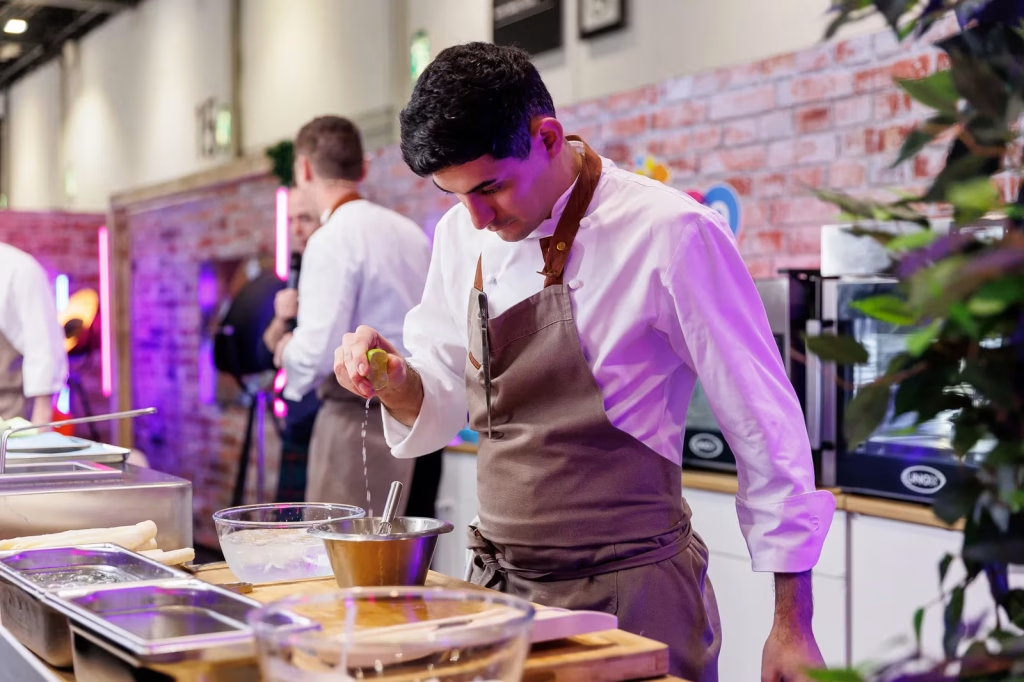
Product Testing (IHUT, CLT, in-restaurant)
Test the product where it lives, not where it is convenient.
What it is
Three product testing formats, each designed for the place food and drink products are actually used. In-home usage testing (IHUT) for retail and grocery products, where preparation, consumption and repeat usage matter. Central location testing (CLT) for controlled comparison testing where direct head-to-head against the competition or a benchmark is the priority. In-restaurant testing for foodservice and menu products, where the kitchen, the service moment and the eating context all shape the consumer response. We choose the format around the product and the decision behind it, not around the methodology that is most familiar to the team running it.
What you get
- A product testing programme run in the conditions the product will actually be sold and consumed in
- Real consumer reactions captured at the point and moment of consumption
- A senior interpretive read on what the data is saying about the product, not just on the scores
- Implications for refinement, ranging, packaging, menu positioning or launch decision
When to use it
- Before commercial commitment, when consumer evidence is the gate to the next investment
- For pre-launch product evaluation in retail (IHUT) or foodservice (in-restaurant) contexts
- For controlled comparison or claims testing against competitive products (CLT)
- When existing testing has overstated product performance versus in-market reality
- For range optimisation across multiple products in real consumption context
Which format for which brief
- IHUT: retail and grocery products that need home preparation and consumption
- CLT: head-to-head comparison, claims testing, controlled benchmarking
- In-restaurant: foodservice products, menu items, products that depend on service context
-
 Explore
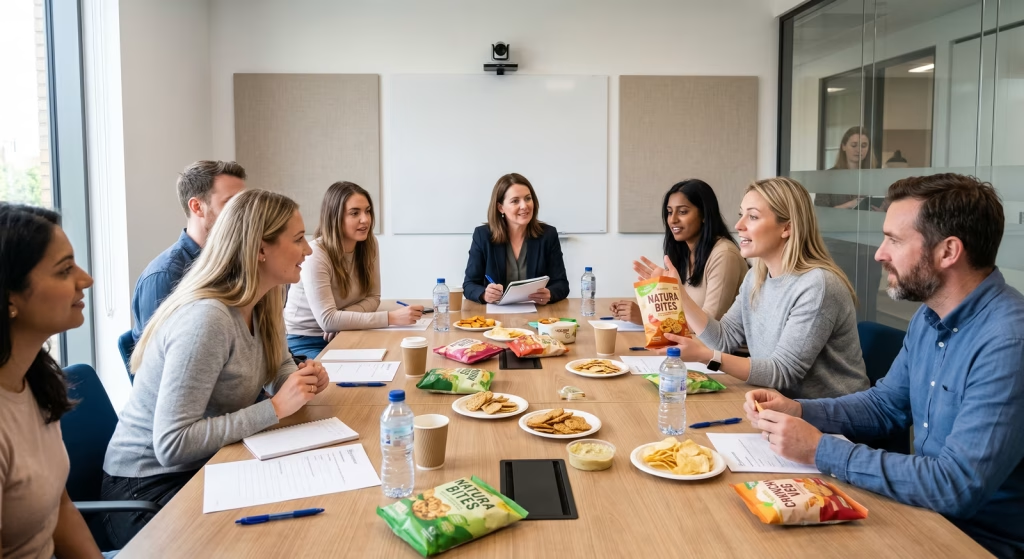
Qualitative Product Testing
Read the why behind the preference score.
What it is
Deeper, qualitative product evaluation that goes beyond preference scores and topline metrics to understand the specific drivers of consumer response. Used when the quantitative testing has surfaced a question the numbers cannot answer: why does this product overdeliver on one occasion and underdeliver on another, why is the score strong but the verbatim hesitant, why does this format work for one audience but not another. Run by senior researchers who can read what is being said and what is being meant, which is what makes the output usable for refinement rather than only for reporting.
What you get
- A qualitative deep dive into the consumer response behind the quantitative scores
- A senior interpretive read on the drivers of preference, rejection or hesitation
- Documentation of what the consumer is actually telling you about the product, not just how they rated it
- Implications for refinement, repositioning or further product development
When to use it
- After quantitative testing has surfaced a question the numbers cannot answer
- When a product is scoring inconsistently across audiences, occasions or use cases
- Before a commercial decision when qualitative evidence is needed to support the case
- For refinement work where the team needs to understand what to change and why
-
Explore
Menu Testing
Test the menu in the conditions it will be ordered, prepared and eaten.
What it is
Menu testing in real or controlled foodservice environments, designed to confirm what works on the plate, in the operation and against the price point. Distinct from Menu Development on the innovation side: development builds the menu, testing validates a menu that already exists (whether built by us or by your internal team). Used for new menus, refreshed ranges, seasonal launches or strategic tests before national or multi-site roll-out. The work captures consumer reaction, operational reality and commercial performance in one integrated read, so the menu that goes live has been validated where it will actually run.
What you get
- A menu testing programme run in real or controlled foodservice environments
- Consumer reaction, operational performance and commercial read captured in one integrated programme
- A senior interpretive read on which dishes earn their place and which do not
- Implications for menu architecture, dish refinement, pricing and roll-out sequencing
When to use it
- Before a new menu launch or major menu refresh
- For seasonal range validation before national or multi-site roll-out
- When a menu is underperforming and the team needs to understand why
- For pricing or positioning decisions where the menu architecture is the variable
How we run insight tools work
-
We scope around the gate review the testing has to pass
Twenty minutes on a scoping call. You tell us what is being tested, who has to be convinced by the result, and what the next investment decision behind the testing is. We tell you which combination of tools will get you to a defensible answer, with the format scoped around the product and the consumption context rather than around the methodology the team is most familiar with.
-
Match the format to the place the product lives
Retail products tested in homes. Foodservice products tested in restaurants. Comparison work run in central locations where the head-to-head is the explicit point. The format choice is the most consequential design decision on a product testing programme, and it is made around where the product will actually live and be consumed, not around what is easiest to deliver from a fieldwork perspective.
-
Senior food specialism on the interpretation
Generic research agencies running food tests deliver clean data and generic interpretation. The data is right. The recommendation is generalisable. And the team uses it for confidence rather than for change, because nothing in the interpretation has read the food signal in the data. Every project on this page is led by a senior food and drink specialist who is in the work from scoping to readout, with the operational reality of the category already in the team.
-
A read built for the next move, not for the test
We close with a clear read on the product, the menu or the application, scoped to the next decision: refine, drop, scale, launch. The output is not a 300-page testing report. It is a recommendation built for the team that has to act on the result, with the supporting evidence sized for the people who will challenge it. Built for what comes next, not for the methodology behind it.
Choosing between the two toolkits
Insight tools and innovation tools on this challenge are designed to work together, but most programmes lean one way at the start. A short decision helper to point you to the right entry point.
Insight tools are the right starting point when:
- You have a prototype, product or menu already and need to test it
- The brief is “validate this” rather than “create this”
- Real-world consumer testing in the conditions the product will be sold in is the immediate need
- You need a defensible read on product performance against competition or a benchmark
- The output needs to support a gate review with consumer evidence
Innovation tools are the right starting point when:
- You need to build a prototype, develop a menu or create an application showcase
- The brief is “make this real” rather than “test what we have”
- The product, menu or application does not exist yet and needs creating
- You need internal teams to experience the product to sell or develop it credibly
- The development clock is ticking on a specific commercial milestone
Most build-and-test programmes use both, with innovation tools building the prototype, menu or application and insight tools testing the result. If you are not sure which entry point is right, the scoping call is the fastest way to find out.
Tested where it lives. Not where it is convenient.
Most food and drink product testing earns a clean score and watches the product underperform in market. The fieldwork is sound. The sample is representative. The methodology is defendable. And the conditions are not. Sterile testing environments produce sterile results, and the products that scored well in those conditions struggle in the real ones because the test never asked them to. The number was true. The context was not.
Three things keep our testing work commercially honest. First, specialism. Food and drink is the only sector we serve, which means the senior team can read a product, a menu and a kitchen the way an experienced operator or product developer would, surfacing what the verbatim and the score are saying together about format, occasion, price perception and competitive set. Second, the environment. We run the test in the place the product will actually live: in the home for retail, in the restaurant for foodservice, in central locations only when controlled comparison is the explicit point of the brief. Third, the senior layer. Every project on this page is led by a senior food and drink specialist who is in the work from scoping to readout. The interpretation comes from someone who has eaten the food, not from someone who has only seen the data.
We are not a research agency that runs IHUT to a script. We are not a fieldwork provider that delivers a tabulated report and a topline. We are the team that runs product testing with food and drink specialism baked into the interpretation, so the read on what is happening to the product in market is sharper than the score alone would suggest.

Tested the product. What comes next?
Insight tools deliver a validated product with consumer evidence behind it. Most build-and-test programmes follow that validated product into one of two next moves, depending on whether the testing has confirmed the product is ready for commercial commitment or whether the testing has surfaced refinements that need to be made first.
The natural forward move beyond this challenge
Challenge 05: Launch and Scale Innovation Successfully
The product is validated, the testing is clean, the brief now needs the commercial route to market. Retailer pitch support, briefing pack creation, manufacturing solutions, volumetric forecasting and REVU post-launch evaluation. The work that takes a validated product and turns it into a launched and scaled commercial proposition.

Innovation tools: more building
Some testing work surfaces that the prototype, the menu or the application needs refinement before commercial commitment. When that is the case, the right move is back across to innovation tools for the build refinement the testing has identified. An R&D sprint to iterate the prototype. A menu development cycle to reshape the dishes that did not land. An application showcase to bring the refined product to life for the next buyer meeting.
Product and menu testing, every channel in food and drink
-
FMCG and branded manufacturers -
Grocery, retail and own label -

Food service -
QSR and high street -
Hospitality
Testing that validated the product
Two projects across different tools.


FAQs
IHUT (in-home usage testing) puts the product in the consumer’s own home, where they prepare it, eat it and live with it across multiple usage occasions. CLT (central location testing) brings consumers into a controlled environment where direct head-to-head comparison or repeat-exposure testing is the priority. In-restaurant testing places the product in a real or simulated foodservice environment, capturing the kitchen, the service moment and the eating context together. We choose the format around the product and the decision behind it, not as a default.
A focus group discusses a product or idea. Qualitative Product Testing has the consumer actually use, prepare and consume the product, with the qualitative depth captured in real usage context rather than in a discussion room. The two formats answer different questions: focus groups read response to an idea or stimulus, qualitative product testing reads response to the product in use. For most product validation work, qualitative product testing is the more useful tool. Focus groups belong earlier in the lifecycle, around concept refinement.
Menu Development builds the menu. It sits on the innovation tools side and is the right tool when the dishes do not exist yet. Menu Testing validates a menu that exists, whether built by us, by your internal team or by another agency. It sits on this page and is the right tool when the menu has been developed and the question is whether it will land. Many programmes use both: development to build, testing to validate.
A CLT can run in three to five weeks from brief to readout. A standard IHUT typically runs in five to eight weeks including recruitment, in-home placement and consumer feedback. In-restaurant testing depends on the operator and the live testing window, but typically runs four to eight weeks. Qualitative Product Testing runs four to seven weeks depending on the depth of qualitative work needed. Menu Testing varies most: real-environment work runs six to ten weeks; controlled-environment work can run in four to six weeks. We give realistic timelines at proposal stage tied to the commercial decision the testing is supporting.
We run fieldwork through our specialist fieldwork capability inside the FIS Group, which means the operational delivery (recruitment, in-home placement, central location facility management, in-restaurant testing logistics) is run by a team that specialises in food and drink fieldwork rather than by a generalist supplier. The fieldwork service page underneath this sub-index explains the operational delivery in more detail.
Either. Each tool is available as a standalone piece of work and that is how most are commissioned. A single IHUT for a pre-launch product evaluation. A single CLT for a competitive benchmarking exercise. A single Menu Testing programme before a roll-out. Programmes that combine several of the tools are scoped against the specific testing requirement rather than around a fixed bundle.
Need to test the product where it will actually be eaten?
Tell us what is being tested, who has to be convinced by the result, and what the next investment decision behind the testing is. We will tell you which testing format (or which combination) will get you to a defensible answer, in what timeline, with what depth of consumer evidence behind it. Twenty minutes on a scoping call with a senior product testing specialist.