

When the integration between launch stages is what protects commercial value
Most major food and drink innovation launches fail at the integration. The concept work is solid; the development work is competent; the testing is thorough; the manufacturing setup is functional; the commercial launch is professional. But the integration between stages loses commercial value: handovers between teams lose context, decisions get made against the stage rather than against the programme, the cumulative effect is innovation work that loses commercial value or commercial momentum somewhere across the journey from concept to commercial launch. The individual stages were each well-executed; the integrated programme was not.
The structural problem is that most brands manage major launches as a sequence of discrete service engagements with internal programme management providing the integration. The model works for routine launches; it breaks at scale because the programme management complexity exceeds internal capacity, the handovers between external service engagements introduce friction, and the cumulative interpretive layer across the journey gets handed off rather than sustained. Major launches need integrated programme management with single senior accountability rather than discrete service work coordinated internally, particularly when the commercial commitment is substantial and the commercial timeline is fixed.
Product Concept-to-Launch Programmes is the integrated programme management methodology for major food and drink launches. One cross-functional senior team accountable for the full journey from concept stage through to commercial launch and scale. The team brings together every discipline the programme needs (concept development, innovation, testing, manufacturing, commercial, creative) and integrates them as one engagement rather than as discrete service workstreams. Senior food and drink specialists run the interpretive layer continuously across stages, with the programme coherence protected at every handover and the cumulative commercial value preserved across the journey.
It is not the right tool for every brief. If the brief is a discrete service engagement (single Retailer Pitch Support, single 3PM sourcing, single testing project), the discrete service is more proportionate than the integrated programme. If the brief is routine launch work that fits within internal programme management capacity, the integrated programme adds engagement complexity without commensurate commercial value. If the brief is single-stage work that does not need cross-stage integration, the relevant single-service alternative is structurally different. Product Concept-to-Launch Programmes sits specifically when the brief is major launch work where integrated programme coherence is commercially critical and the discrete service alternative would erode commercial value at handovers.
What we do differently
-
Single senior team accountable end-to-end
The structural difference between Product Concept-to-Launch Programmes and discrete service engagement. Discrete services are accountable for their specific scope; the integration falls to the client team. Our integrated programmes commission single senior accountability across the full programme: one senior team manages the interpretive layer through every stage, owns the integration at every handover, retains the cumulative commercial context throughout. The accountability shape is structurally different from coordinating multiple service engagements, which is what makes integrated programme management commercially distinct rather than just packaged services.
-
Cross-functional integration built in rather than coordinated
The methodological core. Major launches need cross-functional capability (concept work, innovation, testing, manufacturing, commercial, creative) and discrete service engagement gets this through coordination across multiple engagements with handovers between them. Our integrated programmes build cross-functional integration in from the start: the team operates as one engagement with embedded cross-functional capability rather than as separate workstreams. The integration is structural rather than procedural, which is what makes the programme deliver commercial coherence rather than just stage completion.
-
Programme management that protects commercial momentum
The operational reality. Major launches lose commercial value when stages slip, handovers introduce friction, or programme management complexity exceeds capacity. Senior programme management is built into the integrated engagement: the senior team owns the timeline, manages the dependencies, holds the stages accountable, manages the inevitable surprises proactively rather than reactively. The programme management is what makes the integrated approach deliver commercial momentum rather than just structural integration, particularly when the commercial timeline is fixed and the launch window is unforgiving.
-
Designed for major launches where commercial value justifies the engagement
The commercial framing. Integrated programmes carry more engagement complexity than discrete services and the commercial value has to justify it. We do not propose integrated programmes for routine launches that internal programme management can handle credibly; we propose them where the major launch context (substantial commercial commitment, multi-stage integration complexity, time-critical commercial timeline, board or strategic significance) makes the integrated commercial value real. We will recommend discrete service combinations honestly when the integrated programme would add engagement complexity without commensurate commercial value.
Six commercial use cases, written as scenarios a buyer will recognise from their own brief. The aim is for the reader to see their question on this list and self-select.
Major new product launches at scale
You are launching a major new product (significant commercial commitment, board-level visibility, multi-retailer or multi-channel scope) and need integrated programme management from concept stage through to commercial launch. Concept-to-Launch Programmes manages the integrated programme: concept work, development, testing, manufacturing setup, commercial launch support, all as one engagement with single senior accountability throughout. Suited to launches where the commercial stakes warrant integrated capability rather than coordinated discrete services.
Strategic range launches for retailer category review windows
You are launching a strategic range tied to a major retailer category review window where the commercial timeline is fixed and the programme has to deliver against the review date. Concept-to-Launch Programmes runs the time-critical integrated programme, with the methodology scoped specifically for the review window pressure and the cross-stage integration the launch requires. Critical when the launch involves multiple stages running in compressed parallel rather than sequential timelines.
Foodservice menu programme launches across networks
You are launching a major menu programme across a foodservice network (national QSR rollout, casual dining network refresh, hospitality group rollout) and need integrated programme management across the development, testing, operational deployment and commercial launch stages. The foodservice equivalent of FMCG major launch programmes, with the methodology adapted for foodservice operational reality (operator integration, kitchen capability, service workflow, multi-venue rollout).
Scale-up brand commercial launch programmes
You are a scale-up brand launching at significant commercial scale (major retailer listing wins, multi-channel launch, scale that exceeds internal programme management capacity) and need specialist support to run the integrated programme. Concept-to-Launch Programmes provides the integrated programme capability scale-up brands often lack internally, with the scope evolving as the brand scales rather than as one-off project work. Particularly relevant when the scale-up commercial trajectory has outpaced internal programme management capacity.
International market entry launch programmes
You are entering a new market (UK brand entering Europe or US, international brand entering UK, EMEA expansion programme) and need integrated programme management for the market entry launch: market-specific innovation work, testing for the new market, manufacturing setup for the market, commercial launch support against the new retailer or foodservice network. Concept-to-Launch Programmes manages the integrated international launch programme with the methodology scoped for cross-market reality.
Strategic innovation pipeline integration
You have a strategic innovation pipeline (multiple connected launches across a defined period rather than a single launch event) and need integrated programme management that holds the pipeline coherent rather than treating each launch as a discrete project. Concept-to-Launch Programmes runs as ongoing pipeline integration, scoped against the pipeline rather than against a single launch, with the senior team holding the cumulative pipeline context across launches and ensuring pipeline coherence over the engagement period.
-
How a Concept-to-Launch Programme runs
From major launch brief to integrated commercial outcome
-
Scoping call
Twenty minutes on a call. You tell us the launch context (which products, which commercial scale, which timeline, what is at stake commercially), the stages in scope (concept work, development, testing, manufacturing, commercial launch, post-launch optimisation), the existing innovation work the programme builds on, the integration with your internal programme management and the timeline. We tell you whether Concept-to-Launch Programmes is genuinely the right tool, what programme architecture makes sense, what cross-functional team composition the brief requires and roughly what it will cost. Where the brief would be better served by a combination of discrete services (Retailer Pitch Support, 3PM Manufacturing Solutions, Product Testing commissioned separately), by internal programme management with selective external service support, or by a different approach entirely, we will recommend the right alternative honestly.
-
Programme architecture and team scope
Senior team designs the programme architecture: stages in scope and stages out of scope, dependencies between stages, timeline architecture, decision points and gates, integration model with the client internal team, governance structure and decision rights. The cross-functional team composition gets scoped against the programme architecture (which specialists are needed across which stages, where senior accountability sits, where embedded versus on-call capability is right). Architecture and team scope signed off by the client before the programme opens, so the engagement is scoped against an agreed structure rather than against open-ended assumptions.
-
Integrated stage workstreams
The cross-functional team runs the integrated stage workstreams: concept work where in scope, development through R&D Sprints or Menu Development, testing through Product Testing or Menu Testing, manufacturing through 3PM Manufacturing Solutions, commercial launch through Retailer Pitch Support and Briefing Pack Creation, forecasting through Volumetrics, post-launch optimisation through REVU. Each workstream uses the relevant FIS Group methodology, but integrated as one programme rather than as separate engagements. The integration is what makes the workstreams cumulatively deliver more than the sum of discrete service engagement.
-
Senior interpretive layer across stages
The senior team runs the interpretive layer continuously across stages: making decisions in stage X with the context of stage Y and stage Z preserved, holding the cumulative commercial logic across the journey, managing the programme integration at every handover, retaining the strategic commercial intent even when individual stages create pressure to compromise it. The interpretive layer is what makes the programme commercially coherent rather than just structurally integrated, and is the specific value that single senior accountability delivers over discrete service coordination.
-
Launch and post-launch integration
The commercial launch happens with the integrated programme work behind it; post-launch integration manages the operational reality (early sales data interpretation, manufacturing performance, retailer relationship management, consumer reception). Where the programme includes ongoing optimisation (REVU integration, pipeline integration for connected launches), the engagement continues into the post-launch period with the senior team managing the integration rather than handing over and disengaging. The post-launch integration is where most discrete service engagement ends; for integrated programmes it is where the cumulative commercial value across the launch journey gets captured.
Three formats. Scoped against the programme commercial scale and integration depth.
Concept-to-Launch Programmes flex against the launch commercial context and the programme scope. The three formats below are the typical engagement shapes, with the format selected at scoping rather than assumed. Focused programmes for single major launches with contained scope; strategic launch programmes for major launches with multi-channel or multi-retailer scope; pipeline integration programmes for ongoing strategic innovation pipelines across multiple connected launches.
Focused launch programme
Single major launch with contained scope (one product or focused range, defined commercial moment, single primary channel), typically running across four to nine months from scoping to post-launch integration. Cross-functional team scoped to the focused brief; full integrated programme across the stages in scope; single senior accountability throughout. The most common Concept-to-Launch Programme format and the cleanest commercial proposition for major single launches where integrated capability is commercially critical.

Strategic launch programme
Major launch with multi-channel or multi-retailer scope (significant range launch across multiple retailers, foodservice menu programme across operator network, integrated launch across FMCG and foodservice channels), typically running across six to twelve months from scoping to post-launch integration. Cross-functional team scoped for multi-channel complexity; full integrated programme with cross-channel coherence managed across the engagement; senior accountability for the cumulative strategic commercial outcome. Suited to substantial commercial moments where the multi-channel complexity exceeds discrete service coordination capacity.
Pipeline integration programme
Ongoing strategic innovation pipeline integration across multiple connected launches, typically running across twelve months or longer as a sustained engagement. Cross-functional team scoped for ongoing pipeline integration; programme architecture flexes across launches within the pipeline; senior team holds the cumulative pipeline context across the engagement period. Suited to strategic innovation contexts where the pipeline coherence across launches is the commercial value, and where individual launches gain commercial value from the pipeline integration rather than as standalone events.

Food and drink is all we do
We are not a generalist management consultancy that takes the occasional food and drink launch brief or a creative agency that adds programme management on top of campaign work. Food and drink is the only sector we work in, and our senior team runs integrated launch programmes for food and drink brands continuously rather than dipping in from other sectors. The integration methodology is sector-specific: knowing how innovation work translates into manufactured product in food and drink specifically, knowing how retailer commercial timelines work in this sector, knowing what the realistic landing points are across stages. Generic management consultancies can run programme methodology; sector specialists can run programme methodology calibrated against food and drink commercial reality.
That focus is why we work with 11 of the UK’s top 40 food and drink brands.
The component services within a Concept-to-Launch Programme
Concept-to-Launch Programmes integrate multiple FIS Group services as one engagement. Below are the most common component services within an integrated programme, available as discrete services where the brief is contained or as integrated workstreams where the programme integration is commercially critical.
-

Retailer Pitch Support
Specialist pitch support for food and drink brands presenting to retailers, foodservice operators and trade buyers.
-

Briefing Pack Creation
Specialist materials craft for food and drink brands pitching to retailers, foodservice operators, trade buyers and internal commercial audiences.
-

3PM Manufacturing Solutions
Manufacturing partner support for food and drink businesses. Supplier mapping, specification, trials and scaling production. We do not own manufacturing or place orders.
-

Volumetrics
Specialist volume forecasting for food and drink brands launching new products, ranges or menus.

View our case studies
-
Factor 75
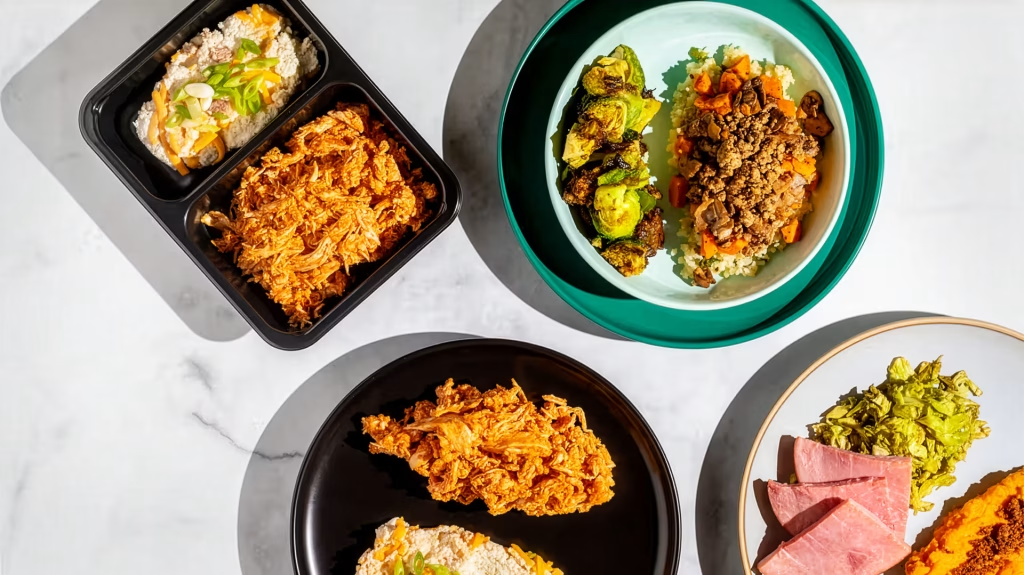
Factor 75 needed rapid recipe development across multiple dietary requirements while integrating seamlessly with their existing process. FIS Group embedded a development team inside Factor's Chicago facility, delivering 25 compliant recipes across GLP-1, keto and low carb requirements and establishing a scalable model for ongoing portfolio expansion.
-

HelloFresh
HelloFresh needed a clear, consumer-evidenced view of where their next stage of growth could come from. FIS Group combined international qualitative research, data mining and a two-day innovation workshop to produce a prioritised pipeline across three platform roadmaps, grounded in both fresh insight and the company's own knowledge base.
-

Superkeen
Superkeen needed rapid development of allergen-free products to support their expansion beyond cereals. FIS Group delivered a fast-paced sprint across two categories – nut butter concepts and tigernut cereal bars – producing signed-off gate zero samples meeting strict AIP requirements, ready for manufacturing briefs.
FAQs
Three structural reasons: single senior accountability across the full programme rather than distributed across multiple discrete engagements (the integration falls to us rather than to the client team), cross-functional integration built in rather than coordinated through handovers (the team operates as one engagement with embedded cross-functional capability), and senior interpretive layer sustained across stages (decisions in each stage get made with full programme context rather than against stage scope alone). For routine launches that internal programme management can handle credibly, discrete services are more proportionate; for major launches where the integration complexity exceeds internal capacity and the commercial commitment is substantial, the integrated programme delivers commercial value that discrete coordination cannot.
Yes, and this is the most common procurement pattern. Concept-to-Launch Programme components (Retailer Pitch Support, Briefing Pack Creation, 3PM Manufacturing Solutions, Product Testing, Volumetrics, REVU and other Challenge 04 and Challenge 05 services) are available as discrete services. For briefs where only specific components are needed, the discrete services are the right choice. The integrated programme adds commercial value specifically when the integration across components is what matters; for briefs that need one or two components without integration, the discrete services are more proportionate. We will recommend the right choice honestly at scoping.
Multiple integration models depending on the brief. Some integrated programmes run with our senior team holding primary programme accountability, with the internal client team integrated into governance and decision rights. Some run with shared programme accountability where the internal team and our senior team co-manage the programme. Some run with our team as embedded specialist capability supporting internal programme management leadership. We design the integration model at the programme architecture stage based on the internal team context, the programme complexity, and where the most appropriate accountability sits.
Three practical integration mechanisms: single senior team continuity across stages (the same senior specialists are accountable across the programme rather than handing off between specialist teams at each stage), embedded cross-functional capability within the team (concept, innovation, testing, manufacturing, commercial, creative specialists working as one engagement rather than as separate workstreams), and continuous programme governance (single decision-making framework across stages rather than separate decision processes for each discrete service engagement). The integration is structural rather than procedural, which is what makes the programme deliver coherent commercial outcomes rather than aggregated stage outputs.
Sector specialism and operational depth. Generic management consultancies run programme methodology across sectors, with food and drink-specific knowledge dependent on the consultancy’s specific experience (often limited). Our Concept-to-Launch Programmes are sector-specific throughout: every component of the integrated programme draws on food and drink-specific specialist capability, the integration methodology is calibrated against food and drink commercial reality, and the senior team works in food and drink continuously rather than rotating across sectors. Generic management consultancies can manage integrated programmes structurally; sector specialists can manage integrated programmes calibrated for the specific commercial reality of food and drink launches.
Programme architecture flexes to the launch brief. Typical stages in scope: concept work, development (R&D Sprints or Menu Development depending on FMCG or foodservice context), testing (Product Testing, Qualitative Product Testing or Menu Testing depending on the brief), manufacturing setup (3PM Manufacturing Solutions where third-party manufacturing is required), commercial launch support (Retailer Pitch Support, Briefing Pack Creation), forecasting (Volumetrics), post-launch optimisation (REVU). The stages in scope get scoped at programme architecture based on what the launch genuinely needs versus what the client team handles internally. Some integrated programmes scope all stages; some scope a subset where the integration is commercially critical.
Four to nine months for focused launch programmes (single major launch, contained scope). Six to twelve months for strategic launch programmes (multi-channel or multi-retailer scope). Twelve months or longer for pipeline integration programmes (ongoing strategic engagement across multiple connected launches). Compressed timelines are possible for focused briefs where the existing innovation work is strong and the launch context is well-defined; major strategic programmes with substantial multi-stage integration complexity typically run longer. Realistic timelines at proposal stage.
Yes, with careful scoping. UK and European Concept-to-Launch Programmes run through our established sector relationships. Selective US and UAE programmes for specific briefs. International integrated programmes have higher operational complexity than single-market because every stage of the integrated programme has to handle cross-market reality (innovation calibration, testing localisation, manufacturing network differences, retailer or foodservice operator dynamics per market). We will scope international capability honestly at the scoping call based on the specific markets and the integrated programme requirements.
The integrated commercial launch and the operational integration that makes it succeed. Specifically: every stage deliverable that the integrated programme includes (concept work output, development output, testing evidence, manufacturing partner work, commercial launch materials and pitch support, forecasting outputs, post-launch optimisation), plus the integrated programme management that delivers cross-stage commercial coherence (programme governance, senior interpretive layer, integration across stages, ongoing commercial momentum management). Format agreed at the start so the programme feeds the commercial launch rather than reading as a research or strategy report.
Programme-based, scoped against the programme format (focused, strategic, pipeline integration), the stages in scope, the cross-functional team composition, the integration depth, the geographic scope and the engagement duration. Focused single-market UK launch programmes are the lowest entry point; strategic multi-market multi-channel programmes or sustained pipeline integration programmes are the highest. Integrated programmes carry more engagement complexity than discrete services and the commercial value has to justify it; we give a clear, all-in quote at proposal stage with honest scoping including a comparison against the discrete service alternative cost so the procurement choice is genuinely informed.
Got a major launch where integrated programme management is what protects the commercial outcome?
Tell us the launch context, the stages in scope, the existing innovation work the programme builds on, the integration with your internal programme management, and the timeline. We will tell you whether Product Concept-to-Launch Programmes is genuinely the right tool, what programme architecture makes sense, what cross-functional team composition the brief requires and what it will cost. Where discrete service combinations, internal programme management with selective external support, or another approach would be better, we will recommend the right alternative honestly with the commercial logic explicit.